

Apple’s biggest Siri upgrade is finally here. Discover the seven AI-powered Siri features changing how people use their iPhones, what’s available now, and what Apple still needs to prove.
Quick Overview: What’s New With Siri AI?
| Feature | Why It Matters |
|---|---|
| Personal Context Awareness | Siri can better understand information across apps |
| Advanced App Actions | More tasks can be completed with fewer steps |
| Natural Conversations | Follow-up questions feel more natural |
| On-Screen Awareness | Siri understands what you’re viewing |
| AI Writing Assistance | Draft, edit, and summarize content faster |
| Apple Ecosystem Integration | Better continuity across Apple devices |
| Privacy-First AI | More intelligence processed on-device |
Siri Is Finally Getting the Upgrade iPhone Users Have Been Waiting For
When Siri launched in 2011, it felt like a glimpse into the future.
For the first time, millions of people could talk to their phones and receive useful responses. At the time, it was one of the most innovative features available on any smartphone.
More than a decade later, however, many users felt Siri had fallen behind.
While the assistant remained useful for setting timers, sending messages, creating reminders, and controlling smart home devices, it often struggled with more complex requests.
I’ve used Siri regularly since its early days, and one limitation has always stood out.
Siri works well when requests are simple.
The moment a task requires context, multiple apps, or several connected actions, the experience often becomes far less impressive.
That’s why Apple’s latest Siri overhaul matters.
Powered by Apple Intelligence, the new Siri is designed to be more personal, more conversational, and significantly more capable than previous versions.
Instead of simply answering questions, Siri is evolving into an assistant that can understand context, connect information across apps, and help users complete real-world tasks.
Some of these capabilities are already available on supported devices, while others continue to roll out through Apple’s ongoing software updates.
Either way, this is the biggest transformation Siri has seen since it first arrived on the iPhone.
When Did Apple Launch the New Siri?
Apple officially introduced its next-generation Siri experience as part of its broader Apple Intelligence initiative.
Rather than releasing every capability at once, Apple has taken a phased approach.
The rollout began with Apple Intelligence features on supported devices and continues to expand through software updates.
This strategy allows Apple to improve performance, refine features, and gradually introduce more advanced capabilities without overwhelming users.
For consumers, the important takeaway is simple:
The new Siri is no longer a future concept.
The transition is already underway.
Announcing Apple’s next big step for Siri and iPhone
Why Siri Needed Reinvention
For years, Siri benefited from being first.
The challenge is that being first doesn’t guarantee long-term leadership.
As smartphones became more powerful and artificial intelligence advanced, user expectations changed dramatically.
People no longer wanted assistants that simply answered questions.
They wanted assistants that could:
- Understand context
- Remember conversations
- Connect information across apps
- Automate repetitive tasks
- Help complete complex workflows
Meanwhile, many Siri interactions still felt transactional.
Ask a question.
Receive an answer.
Start over.
That model worked well in the early days of voice assistants.
Today, it feels increasingly limited.
The rise of generative AI accelerated those expectations even further.
Consumers now compare Siri not only to traditional voice assistants but also to modern AI systems capable of understanding natural language, generating content, and managing complex requests.
Apple’s AI strategy appears to be a direct response to those changing expectations.
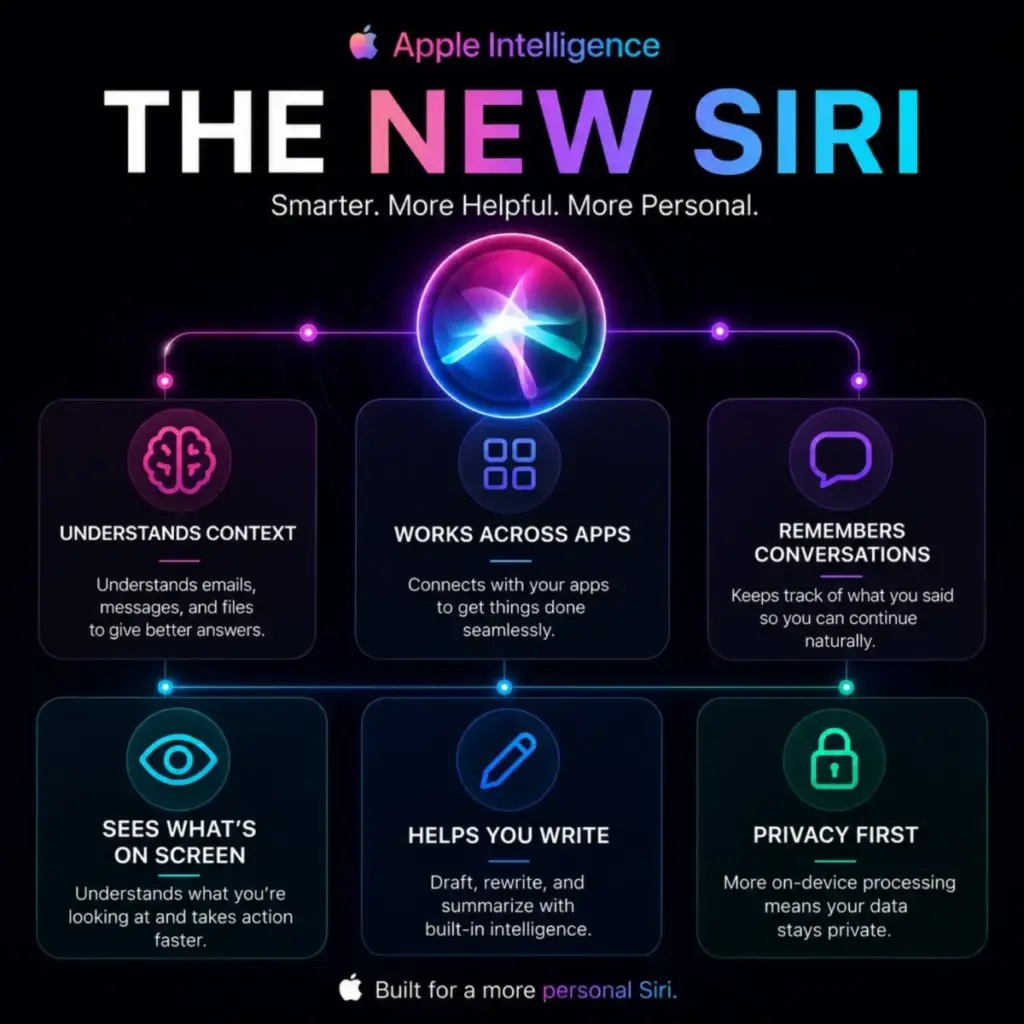
1. Siri Can Understand Personal Context Better Than Before
One of the biggest changes coming to Siri is improved contextual understanding.
People don’t think in isolated commands.
Throughout the day, we move between emails, messages, notes, meetings, photos, files, and reminders.
We naturally connect information across those experiences.
The new Siri is designed to do more of the same.
Imagine saying:
“Find the presentation Sarah shared before our team meeting.”
Instead of requiring exact file names or dates, Siri can increasingly use contextual clues to understand what you’re looking for.
Why This Matters
The biggest productivity improvements often come from eliminating small frustrations.
The less time users spend searching for information, the more valuable an assistant becomes.
2. Siri Can Now Do More Than Answer Questions
Many AI demonstrations focus on conversation.
Most users care more about results.
That’s why advanced app actions may become one of Siri’s most useful upgrades.
Apple is expanding Siri’s ability to interact across apps and perform multi-step actions.
Potential uses include:
- Creating events from emails
- Managing reminders automatically
- Organizing photos
- Sharing content between apps
- Streamlining everyday workflows
Imagine saying:
“Create an album from my vacation photos and share it with my family.”
Tasks that once required several apps and multiple steps could increasingly become a single request.
A Real-World Observation
Most smartphone frustration doesn’t come from difficult tasks.
It comes from repetitive tasks.
Reducing those small interruptions could end up being one of Siri’s biggest strengths.
3. Conversations Feel More Natural
One of the easiest ways to identify an outdated voice assistant is when it immediately loses track of the conversation.
Apple is working to make Siri feel more conversational.
For example:
User: “What’s the weather forecast for New York tomorrow?”
Siri: “Tomorrow looks warm and sunny.”
User: “What about this weekend?”
Instead of asking for clarification, Siri can better understand that you’re continuing the same discussion.
It sounds like a small improvement.
In practice, it makes interactions feel far more natural.
4. Siri Can Understand What’s On Your Screen
Another major addition is on-screen awareness.
Siri can increasingly understand what’s currently displayed on your device and respond accordingly.
Imagine reading an article about a restaurant and saying:
“Add this place to my travel list.”
Rather than copying names and links manually, Siri can use what’s already visible on your screen to help complete the task.
Why This Feature Matters
Many AI features sound impressive during presentations.
On-screen awareness feels different because it solves practical, everyday problems.
5. AI Writing Tools Are Becoming Part of Everyday iPhone Use
Writing consumes a surprising amount of time.
Whether you’re responding to emails, drafting reports, sending messages, or preparing presentations, communication is a major part of modern life.
Apple Intelligence introduces writing tools that can help users:
- Draft content
- Rewrite text
- Summarize information
- Improve grammar
- Adjust tone
- Increase clarity
As someone who spends much of the day writing and editing, I can easily see why these features may become some of the most frequently used AI tools on the iPhone.
6. Siri Is Becoming More Connected Across Apple’s Ecosystem
One area where Apple already excels is ecosystem integration.
The new Siri builds on that advantage.
Information can flow more seamlessly between:
- iPhone
- iPad
- Mac
- Apple Watch
- AirPods
Imagine researching a project on your Mac and later asking Siri about it from your iPhone.
Instead of starting over, Siri can increasingly understand the broader context.
This kind of continuity is something Apple is uniquely positioned to deliver.
7. Privacy Remains a Core Part of Apple’s AI Strategy
Privacy continues to be one of Apple’s biggest differentiators.
While many AI systems rely heavily on cloud-based processing, Apple emphasizes on-device intelligence whenever possible.
That approach provides several benefits:
- Faster responses
- Better security
- Reduced data sharing
- Greater user control
- Improved privacy
For many consumers, privacy remains one of the biggest concerns surrounding artificial intelligence.
Apple’s strategy aims to deliver advanced AI capabilities without sacrificing user trust.
The Bigger Picture
Apple CEO Tim Cook has repeatedly described privacy as a fundamental human right.
As AI becomes more integrated into daily life, trust may become just as important as intelligence.
Who Benefits Most From a Smarter Siri?
The biggest beneficiaries may not be casual users.
Professionals managing large amounts of information, students balancing coursework, entrepreneurs running multiple projects, and anyone who frequently switches between apps could see the greatest value.
In these environments, even small productivity gains can add up quickly.
Saving a few minutes every day may not seem significant.
Over months and years, those improvements become meaningful.
What Apple Still Needs to Prove
While Apple has already launched major parts of its Siri AI strategy, important questions remain.
Users will ultimately judge Siri based on reliability, not announcements.
Several questions still need answers:
- Will contextual awareness work consistently?
- How effective will third-party app integration become?
- Can Apple maintain privacy while expanding AI capabilities?
- Will users trust Siri with increasingly complex tasks?
- How many advanced features will require newer hardware?
These questions matter because consumers don’t evaluate technology based on demonstrations.
They evaluate it based on everyday experiences.
Apple doesn’t need Siri to impress users once.
It needs Siri to work consistently every day.
Final Thoughts
For years, Siri has been useful.
Apple now wants it to be indispensable.
The company’s vision extends far beyond creating a better voice assistant.
It is building an AI-powered experience designed to understand users, connect information, and reduce everyday friction.
The most successful technology often works quietly in the background.
It removes obstacles without demanding attention.
That’s exactly what Apple appears to be aiming for with Siri’s next chapter.
The real test won’t be whether Siri sounds smarter.
It will be whether millions of people begin relying on it without even thinking about it.
If that happens, Apple’s biggest AI achievement won’t be the technology itself.
It will be making everyday tasks feel simpler.
Frequently Asked Questions
What is Apple’s new Siri AI?
Apple’s new Siri AI is an upgraded version of Siri powered by Apple Intelligence, designed to provide more contextual, personalized, and action-oriented assistance.
Is the new Siri available now?
Yes. Apple has already begun rolling out Siri AI capabilities through Apple Intelligence on supported devices, with additional features continuing to arrive through software updates.
Which iPhones support the new Siri?
The most advanced Apple Intelligence features require newer Apple hardware. Availability depends on the device model, region, language support, and software version.
How is Apple’s AI different from competitors?
Apple focuses heavily on privacy, on-device processing, and deep ecosystem integration while expanding AI capabilities.
Can Siri perform actions across multiple apps?
Yes. Apple is expanding Siri’s ability to complete multi-step tasks and interact across multiple apps more intelligently.
Why did many users think Siri fell behind?
Many users felt Siri excelled at basic voice commands but struggled with contextual understanding, conversational memory, and complex workflows compared to newer AI systems.
Is Apple’s AI approach safer for privacy?
Apple’s emphasis on on-device processing is designed to reduce unnecessary data sharing while still providing advanced AI functionality.
Read related articles: