
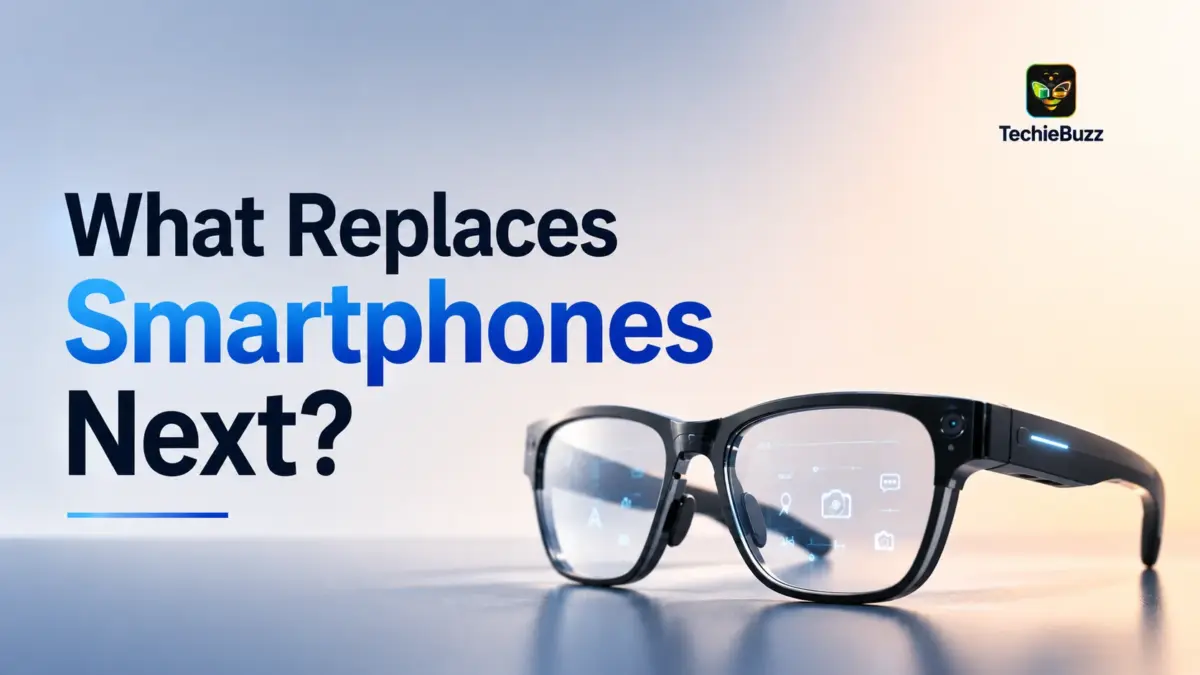
What will replace smartphones in the next decade? Explore 5 technologies, from AR smart glasses to AI wearables, that could redefine how we interact with technology by 2030.
For nearly 20 years, the smartphone has been the center of our digital lives.
It’s our camera, GPS, wallet, music player, gaming device, and communication tool all rolled into one. Few technologies have changed everyday life as dramatically as the smartphone.
Yet something interesting is happening in the tech industry.
The biggest companies in the world are no longer focused solely on building better smartphones. Instead, they’re investing billions of dollars in technologies designed to reduce our reliance on them.
Meta is betting on smart glasses. Apple is pushing spatial computing. AI companies are building assistants that can perform tasks without traditional apps. Researchers are even exploring brain-computer interfaces that could allow people to interact with technology using thoughts alone.
This raises an important question:
What will replace smartphones?
The answer may surprise you.
The most likely future isn’t one revolutionary device replacing your phone. Instead, smartphones may gradually fade into the background as an ecosystem of AI-powered wearables and intelligent devices takes over more of the tasks we perform every day.
Let’s look at the technologies leading that transformation.
Quick Answer: What Is Most Likely to Replace Smartphones?
If you’re looking for the short version, AR smart glasses currently have the strongest chance of becoming the next major computing platform.
However, experts generally don’t expect smartphones to disappear completely by 2030.
Instead, smartphones will likely evolve into background devices while technologies such as smart glasses, AI assistants, wearables, and mixed reality systems become the primary way people interact with digital information.
In other words, the future isn’t about replacing smartphones overnight. It’s about reducing how often we need them.
Which Technology Has the Best Chance of Replacing Smartphones?
Here’s how the technologies compare today:
| Technology | Commercial Readiness | Chance by 2030 |
|---|---|---|
| AR Smart Glasses | High | Very High |
| AI Wearables | Medium | High |
| Mixed Reality Headsets | Medium | Medium |
| Smart Contact Lenses | Low | Medium |
| Brain-Computer Interfaces | Low | Low |
Based on current market momentum, AR smart glasses appear to have the strongest path toward mainstream adoption.
Why the Smartphone Is Reaching a Turning Point
Smartphones continue to improve every year.
The problem is that most improvements are becoming incremental rather than revolutionary.
Think about the last smartphone launch you watched.
The headline features were probably:
- Better cameras
- Faster processors
- Brighter displays
- Longer battery life
Those upgrades matter, but they don’t fundamentally change how we interact with technology.
At the same time, consumers increasingly want experiences that feel more natural.
People want technology that is:
- Hands-free
- Faster to access
- Less distracting
- More personalized
- Better integrated into daily life
Artificial intelligence is accelerating this shift.
Instead of opening apps and tapping through menus, people increasingly expect technology to understand what they want and help them accomplish tasks automatically.
That change could be just as significant as the arrival of smartphones themselves.
The Biggest Mistake People Make About Smartphone Replacement
Most predictions assume a single device will replace smartphones.
History suggests that’s unlikely.
Laptops didn’t replace desktop computers.
Streaming didn’t eliminate television.
Smartwatches didn’t replace smartphones.
New technologies usually coexist with existing ones before gradually taking over specific functions.
The same pattern will likely happen here.
Rather than one device replacing smartphones, we’re moving toward a world where multiple technologies work together.
A future setup might include:
- Smart glasses for visual information
- AI earbuds for voice interaction
- Wearable health devices
- Ambient AI assistants
- Smartphones operating quietly in the background
That’s a far more realistic scenario than a sudden smartphone extinction.
1. AR Smart Glasses: The Leading Contender
If there is one technology attracting the most attention from industry experts, it’s augmented reality smart glasses.
Unlike many futuristic concepts, smart glasses solve an immediate problem.
People constantly check their phones throughout the day.
Smart glasses eliminate much of that friction by bringing information directly into the user’s field of view.
Imagine walking through an unfamiliar city and seeing navigation directions appear in front of you.
Imagine receiving a message, translating a foreign language, or asking an AI assistant for information without reaching into your pocket.
That’s the promise of AR.
Products Already Available
The technology is no longer experimental.
Current products include:
- Ray-Ban Meta Smart Glasses
- XREAL Air series
- Snap Spectacles
While none fully replace smartphones today, they demonstrate how quickly wearable computing is evolving.
Why AR Glasses Have an Advantage
The biggest strength of smart glasses is that they require relatively little behavior change.
People already wear glasses.
That makes adoption easier than many competing technologies.
Likelihood by 2030
Very High
2. AI Wearables: The Rise of Invisible Computing
Artificial intelligence is changing how people interact with technology.
For decades, users adapted to software.
Now software is starting to adapt to users.
Instead of opening apps, searching menus, and clicking buttons, people can increasingly describe what they want in plain language.
AI handles the complexity.
Early Experiments
Products such as:
- Rabbit R1
- Humane AI Pin
Attempted to showcase this future.
Although they faced challenges, they introduced an important idea:
The future may involve conversations rather than apps.
Why This Matters
Imagine saying:
“Book the cheapest flight to Mumbai next weekend and reserve a hotel near the airport.”
A capable AI assistant could complete the entire task.
No apps.
No searching.
No comparison websites.
Just results.
That’s the long-term vision behind AI wearables.
Likelihood by 2030
High
3. Mixed Reality Headsets and Spatial Computing
Another technology attracting enormous investment is mixed reality.
Apple’s Vision Pro helped bring the concept into the mainstream conversation.
Apple rarely enters a category unless it sees long-term potential.
The company describes this category as spatial computing.
The idea is simple:
Instead of looking at a screen, digital content exists around you.
Virtual displays can replace physical monitors, televisions, and in some cases even smartphones.
Current Challenges
Today’s devices are still:
- Expensive
- Bulky
- Battery limited
However, many technologies begin this way before becoming smaller and more affordable.
Likelihood by 2030
Medium
4. Smart Contact Lenses
If smart glasses represent the next step, smart contact lenses may represent the step after that.
Researchers are exploring lenses capable of displaying information directly onto the eye.
Potential applications include:
- Navigation
- Health monitoring
- Real-time translation
- Augmented reality overlays
The appeal is obvious.
No headset.
No glasses.
No visible device.
Technology becomes nearly invisible.
Why Adoption Will Take Time
Engineers still face significant challenges involving:
- Safety
- Battery technology
- Comfort
- Regulatory approval
For that reason, smart contact lenses remain a longer-term opportunity.
Likelihood by 2030
Medium-Low
5. Brain-Computer Interfaces
Brain-computer interfaces are among the most ambitious technologies currently under development.
The concept is straightforward:
Control computers using neural signals instead of physical input.
Companies such as Neuralink have already demonstrated early progress through human trials.
Potential Benefits
Brain-computer interfaces could eventually allow users to:
- Control devices mentally
- Communicate faster
- Operate smart systems
- Access information instantly
For individuals with severe disabilities, the impact could be transformative.
The Reality Check
Despite rapid progress, brain-computer interfaces still face major technical, ethical, and regulatory challenges.
Most experts view them as a long-term technology rather than a mainstream consumer product by 2030.
Likelihood by 2030
Low
What Technology Leaders Are Really Betting On
One useful way to predict the future is to follow where money is being invested.
Meta continues investing heavily in smart glasses and augmented reality.
Apple is positioning spatial computing as a major long-term platform.
AI companies are racing to create assistants capable of replacing traditional app-based workflows.
Although these companies disagree on the exact approach, they share a common goal:
Reducing dependence on handheld screens.
That alignment is one of the strongest signals that computing is entering a new phase.
What Your Daily Technology Setup Could Look Like in 2030
Imagine leaving home in 2030.
Instead of constantly checking a smartphone, you’re wearing lightweight smart glasses connected to an AI assistant.
Your earbuds translate conversations in real time.
Your wearable health device monitors key metrics automatically.
Navigation appears when needed.
Notifications appear only when relevant.
Your smartphone still exists, but it operates quietly in the background.
You interact primarily with intelligent devices designed to fit naturally into daily life.
That future may arrive sooner than many people expect.
Final Verdict
After reviewing current products, industry investments, research initiatives, and consumer technology trends, AR smart glasses appear to be the strongest candidate to reduce smartphone dependence by 2030.
However, the bigger story isn’t which device replaces smartphones.
The bigger story is how computing itself is changing.
The future is moving toward technology that is more intelligent, more personal, and less visible.
Rather than one revolutionary gadget replacing your phone overnight, we’re likely to see smartphones gradually become background devices while AI-powered wearables take center stage.
The post-smartphone era isn’t about carrying a different device.
It’s about needing a device less often in the first place.
Frequently Asked Questions
What is most likely to replace smartphones by 2030?
AR smart glasses currently have the strongest chance due to growing investment, improving hardware, and practical everyday use cases.
Will smartphones disappear completely?
Probably not. Most experts expect smartphones to remain part of the technology ecosystem while becoming less central to daily computing.
Why are smart glasses considered the future?
They provide hands-free access to information and allow users to stay engaged with the real world while interacting with digital content.
Are AI wearables replacing apps?
Potentially. AI assistants are increasingly capable of completing tasks through conversation, reducing the need to manually navigate apps.
Can brain-computer interfaces become mainstream?
They have long-term potential, but widespread consumer adoption is unlikely before major technical, regulatory, and ethical challenges are addressed.