

Learn what Elon Musk’s Starlink is, how its satellite internet network works, how it compares with fiber and 5G, and why it’s transforming broadband access worldwide.
Table of Contents
- The Internet Was Never Built for Everyone
- What Is Starlink?
- Why Did Elon Musk Create Starlink?
- How Traditional Internet Networks Work
- How Starlink Works
- Step 1: Your Starlink Dish Connects to Satellites
- Step 2: Data Travels Through the Satellite Network
- Step 3: Data Connects to the Wider Internet
- Why Starlink Is Different From Older Satellite Internet
- Starlink vs Fiber vs 5G Home Internet
- How Fast Is Starlink Internet?
- Could Starlink Replace Traditional Broadband in the Future?
- Starlink’s Current Position in India
- Advantages of Starlink
- Potential Drawbacks of Starlink
- Why Industry Experts Take Starlink Seriously
- Final Thoughts
- Frequently Asked Questions (FAQs)
The Internet Was Never Built for Everyone
For many people, internet access feels as essential as electricity.
You move into a new home, choose a provider, connect a router, and within minutes you’re streaming movies, joining video calls, backing up files to the cloud, or scrolling through social media.
The connection is so seamless that most of us rarely think about the infrastructure behind it.
Yet for millions of people around the world, reliable internet remains difficult to access.
In remote villages, mountainous regions, islands, farms, deserts, and offshore locations, broadband connectivity can be slow, expensive, or unavailable altogether. The consequences go beyond inconvenience. Without reliable internet, communities can face barriers to education, healthcare, financial services, remote work opportunities, and economic growth.
The challenge isn’t a lack of demand.
It’s a problem of geography, economics, and infrastructure.
Traditional broadband networks require companies to lay fiber-optic cables, install utility poles, build network equipment, and maintain infrastructure across vast distances. In densely populated cities, those investments make sense because thousands of customers can share the cost. In rural areas, providers may need to invest millions of dollars to connect a relatively small number of households.
This reality has helped create what experts call the digital divide: the gap between people who have access to reliable internet and those who don’t.
That is the problem Starlink hopes to solve.
Developed by Elon Musk’s SpaceX, Starlink is a satellite broadband network designed to bring high-speed internet to places where traditional infrastructure struggles to reach. Instead of relying primarily on cables buried underground, Starlink delivers connectivity through thousands of satellites orbiting Earth.
The concept sounds futuristic.
Yet it is already reshaping how internet access is delivered across the world.
From remote ranches in North America and mining operations in Australia to ships at sea and emergency response teams working in disaster zones, Starlink is proving that broadband doesn’t always need to come through a cable.
It can come from space.
What Is Starlink?
Starlink is a satellite internet service operated by SpaceX.
Its mission is simple: provide fast, reliable internet access almost anywhere on Earth.
To use Starlink, customers install a compact satellite dish and Wi-Fi router at their home, business, vehicle, or worksite. Instead of connecting to a nearby fiber line or cellular tower, the dish communicates directly with satellites passing overhead.
Those satellites then relay internet traffic through Starlink’s global network before connecting it to the wider internet.
In practical terms, Starlink moves a significant part of internet infrastructure from the ground into space.
What makes the project remarkable is its scale.
With thousands of active satellites already in low Earth orbit and new launches occurring regularly, Starlink operates the largest satellite constellation ever built. The service has expanded rapidly across multiple continents and has become one of the most ambitious communications projects of the modern era.
While satellite internet itself is not new, Starlink’s approach is fundamentally different from traditional satellite providers.
That difference is what has captured the attention of consumers, governments, and telecommunications experts alike.
Why Did Elon Musk Create Starlink?
Many people assume Starlink exists purely to provide internet access.
The reality is more interesting.
SpaceX was founded with an ambitious long-term goal: reducing the cost of space travel and eventually supporting human settlement beyond Earth.
Those ambitions require enormous amounts of funding.
Rocket launches generate revenue, but they can also be unpredictable and cyclical. A subscription-based internet service offers something different: recurring income from millions of customers.
Starlink was designed to help fund SpaceX’s broader mission while simultaneously solving a real-world problem on Earth.
In other words, the project serves two purposes.
First, it expands internet access to underserved regions.
Second, it creates a potentially massive revenue stream that can support future space exploration efforts.
Few technology projects operate at such different scales simultaneously.
How Traditional Internet Networks Work
To understand why Starlink matters, it helps to understand how most internet services work today.
Traditional broadband relies heavily on physical infrastructure, including:
- Fiber-optic cables
- Telephone networks
- Coaxial cable systems
- Cellular towers
- Regional data centers
- Network switching equipment
Every time you stream a movie, send an email, or visit a website, data travels through this vast web of infrastructure before reaching your device.
This system works extremely well in cities and suburbs.
The challenge appears when providers need to extend that infrastructure into remote regions.
Imagine connecting a small village deep in the mountains or a handful of farms spread across hundreds of kilometers. Technically, it’s possible. Economically, it can be difficult to justify.
This is why many rural communities continue to face limited broadband options despite years of investment and technological progress.
Starlink approaches the problem from a completely different angle.
Instead of bringing cables to people, it brings connectivity from space.
How Starlink Works
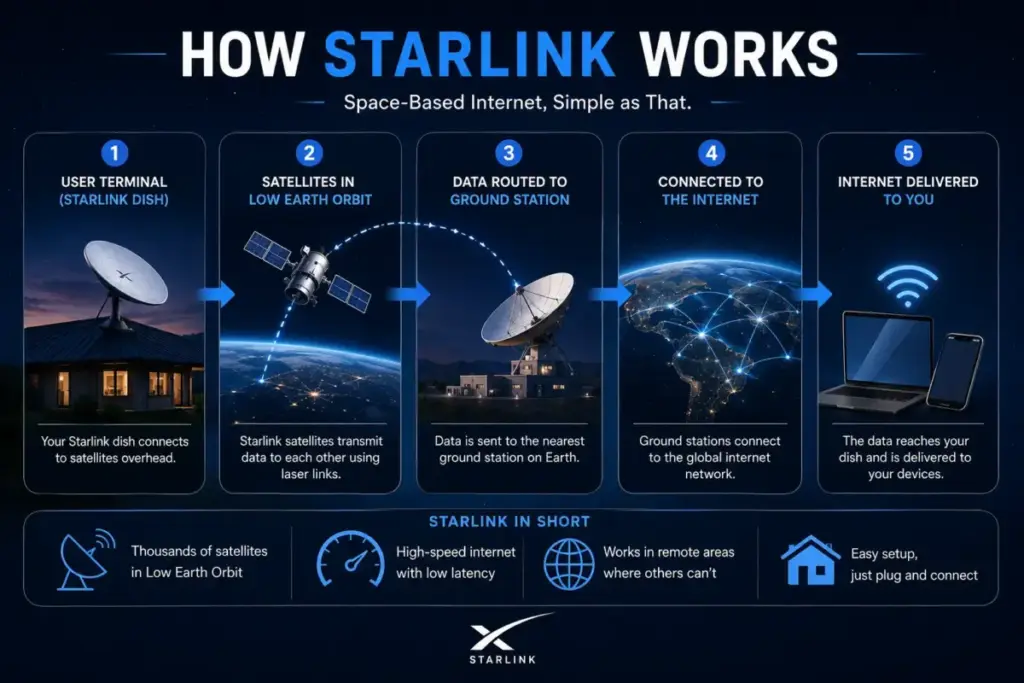
At first glance, Starlink sounds incredibly complex.
Behind the scenes, it absolutely is.
For users, however, the experience is surprisingly simple.
Imagine you’re working from a remote cabin in the Himalayas where traditional broadband infrastructure doesn’t exist.
When you send an email, here’s what happens:
Step 1: Your Starlink Dish Connects to Satellites
The Starlink terminal automatically identifies and communicates with satellites moving overhead.
Unlike older satellite dishes that point toward a single fixed satellite, Starlink’s equipment continuously connects to different satellites as they pass across the sky.
Step 2: Data Travels Through the Satellite Network
Once connected, your internet traffic moves through Starlink’s orbital network.
Many newer satellites are equipped with laser communication systems that allow them to pass information directly to one another in space.
This creates a high-speed network above Earth.
Step 3: Data Connects to the Wider Internet
The information reaches ground stations connected to the global internet before returning through the same route.
All of this occurs in milliseconds.
To most users, the experience feels remarkably similar to using a conventional broadband connection.
The difference is simply where the infrastructure exists.
Much of it is orbiting hundreds of kilometers above Earth.
Why Starlink Is Different From Older Satellite Internet
Satellite internet has existed for decades.
Unfortunately, it also developed a reputation for poor performance.
Users often complained about:
- High latency
- Video buffering
- Slow response times
- Unreliable connections
The main reason was distance.
Traditional satellite internet relied on geostationary satellites positioned approximately 35,786 kilometers above Earth.
Every request had to travel that enormous distance into space and back again.
Even at the speed of light, those distances create delays.
Starlink changed the equation by using low Earth orbit satellites located much closer to the planet.
The result is significantly lower latency and faster response times.
This improvement has made activities such as video conferencing, cloud applications, online gaming, and remote work far more practical.
What was once considered a last-resort internet option has become a legitimate broadband alternative.
Starlink vs Fiber vs 5G Home Internet
The biggest question for most consumers isn’t whether Starlink works.
It’s whether Starlink is the right choice.
| Feature | Starlink | Fiber Internet | 5G Home Internet |
|---|---|---|---|
| Download Speed | High | Very High | Moderate to High |
| Upload Speed | Moderate | High | Moderate |
| Latency | Low | Very Low | Low |
| Coverage | Global and Remote Areas | Limited by Infrastructure | Strong in Urban Areas |
| Installation | Self-Install | Often Requires Technician | Usually Plug-and-Play |
| Reliability | Good | Excellent | Signal Dependent |
| Best For | Rural and Remote Users | Urban and Suburban Users | Areas With Strong 5G Coverage |
The reality is straightforward.
If fiber internet is available at your address, it remains the benchmark for speed and reliability.
If fiber isn’t available, Starlink may be one of the strongest alternatives on the market.
How Fast Is Starlink Internet?
Starlink’s performance varies depending on location, weather conditions, network congestion, and service plans.
For most households, however, the service is capable of supporting:
- 4K video streaming
- Remote work
- Video conferencing
- Online education
- Smart home devices
- Cloud-based applications
- Multiplayer gaming
Typical users often experience speeds that far exceed older satellite internet services and many rural broadband options.
Like any network, performance can fluctuate. Users in densely populated regions may experience different results than those in areas with lower demand.
Could Starlink Replace Traditional Broadband in the Future?
Probably not entirely.
But that doesn’t mean it won’t play a major role.
Fiber-optic networks remain unmatched for speed, capacity, and long-term scalability. Cities and densely populated regions will likely continue relying on fiber for decades.
Starlink’s greatest strength lies elsewhere.
It excels in locations where building traditional infrastructure is difficult, expensive, or impractical.
Rather than replacing fiber, Starlink is more likely to complement it.
The future of internet connectivity may involve a combination of technologies, including fiber, 5G, fixed wireless networks, and satellite broadband working together to close coverage gaps.
In that future, Starlink could become a critical piece of the global connectivity puzzle.
Starlink’s Current Position in India
India is one of the most strategically important broadband markets in the world.
The country has hundreds of millions of internet users, yet many rural and geographically challenging regions still face connectivity limitations.
For Starlink, India represents a significant opportunity.
Areas that could potentially benefit include:
- Himalayan communities
- Northeastern states
- Border regions
- Remote villages
- Island territories
- Offshore operations
Starlink has spent several years navigating regulatory requirements and licensing processes in India.
Its progress has attracted considerable attention because satellite broadband could help expand internet access in regions where traditional infrastructure remains difficult to deploy.
However, the pace and scale of expansion will continue to depend on regulatory approvals, spectrum policies, infrastructure deployment, and market competition.
The Indian satellite broadband market is also expected to include competition from other major players, making the coming years particularly important for the sector.
Advantages of Starlink
Global Reach
Starlink can provide internet access in places where traditional networks struggle to operate.
Faster Deployment
Users don’t need to wait for fiber cables to be extended to their location.
Valuable During Emergencies
Satellite connectivity can remain available when terrestrial infrastructure is damaged by natural disasters or other disruptions.
Strong Rural Connectivity
For many rural households, Starlink represents a significant upgrade over legacy internet options.
Potential Drawbacks of Starlink
Higher Upfront Costs
Users must purchase specialized hardware before activating service.
Weather Can Affect Performance
Heavy rain, snow, and severe weather conditions may occasionally impact connectivity.
Capacity Constraints
Satellite networks have finite capacity. In heavily utilized regions, performance can vary depending on demand.
Obstructions Matter
Trees, buildings, and terrain can interfere with signal quality.
Fiber Still Has Advantages
Where high-quality fiber internet is available, it generally offers superior performance and long-term value.
Why Industry Experts Take Starlink Seriously
Starlink is more than another internet provider.
It represents a shift in how the telecommunications industry thinks about connectivity.
For decades, expanding broadband largely meant building more infrastructure on the ground.
Starlink demonstrates that part of that infrastructure can exist in space.
Its success has encouraged competitors, accelerated investment in satellite communications, and pushed governments and telecom companies to rethink how underserved regions can be connected.
Even if Starlink never replaces traditional broadband, it has already changed the conversation.
Final Thoughts
For much of the internet’s history, geography determined opportunity.
People living in major cities typically enjoyed fast broadband connections, while many rural communities had limited choices.
Starlink doesn’t completely eliminate that reality.
But it narrows the gap.
By delivering internet from space, it offers a practical solution for locations that have long been overlooked by traditional infrastructure.
Will Starlink replace fiber internet?
Unlikely.
Will it become an important part of the future connectivity ecosystem?
Very likely.
For remote workers, farmers, researchers, travelers, and communities beyond the reach of conventional broadband, that may prove to be its most important contribution.
The internet was never built for everyone.
Starlink is one of the most ambitious attempts to change that.
Frequently Asked Questions
Is Starlink available in India?
Starlink has been pursuing regulatory approvals and market entry in India. Availability may vary depending on licensing, infrastructure deployment, and future rollout plans.
Is Starlink faster than fiber internet?
Generally, fiber internet remains faster and more consistent. Starlink is most valuable in areas where fiber is unavailable.
Can Starlink be used for gaming?
Yes. Its lower latency compared with traditional satellite internet makes gaming much more practical.
Does Starlink require a contract?
Service terms vary by region and plan. Users should review the latest offerings available in their country.
Can Starlink be used in RVs, boats, or remote locations?
Yes. One of Starlink’s key advantages is its ability to provide connectivity in mobile and remote environments.
Does bad weather affect Starlink?
Severe weather can occasionally impact performance, although the system is designed to operate in a wide range of conditions.
What equipment comes with Starlink?
A typical Starlink kit includes a satellite dish, Wi-Fi router, cables, and mounting hardware.
Is Starlink worth it?
For users with limited broadband options, Starlink can be a compelling solution. For households with access to high-quality fiber internet, traditional broadband often remains the better choice.
I am now not certain where you are getting your information, but great topic.
I must spend a while studying much more or
understanding more. Thanks for fantastic information I was
searching for this information for my mission.