
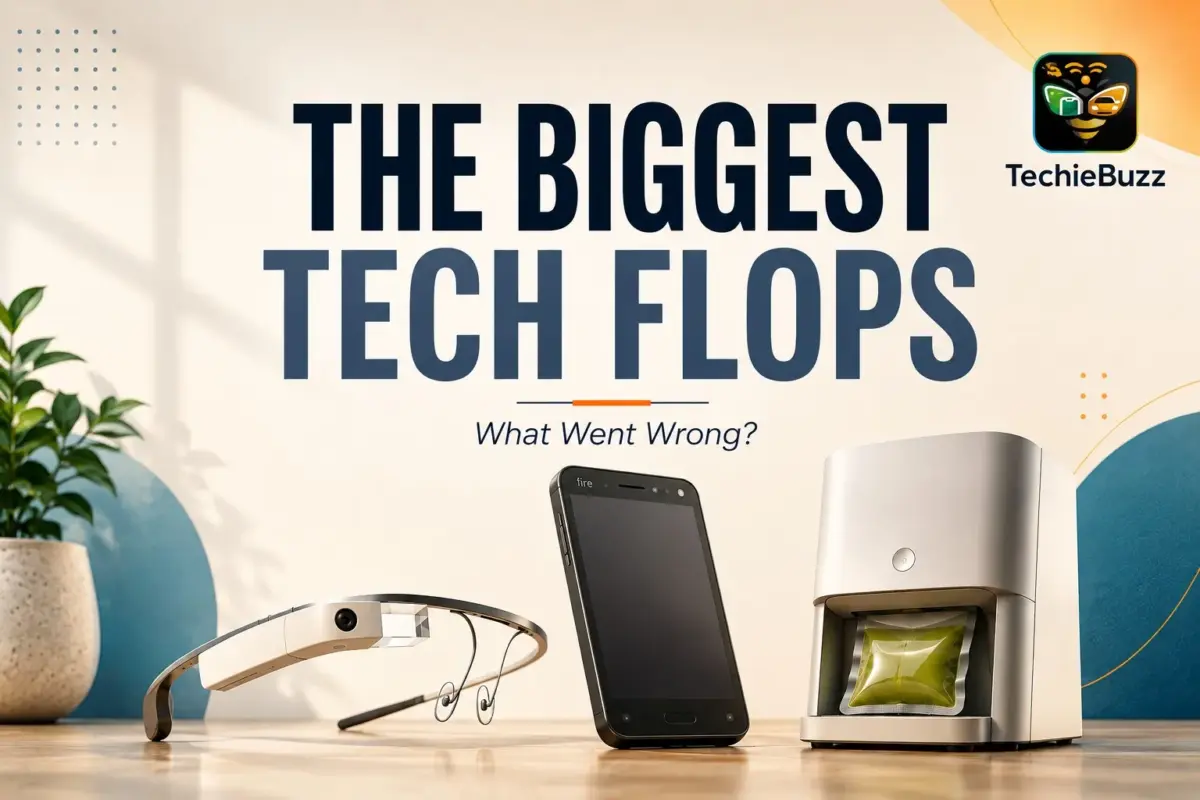
Discover the 5 biggest tech product failures of all time, why Google Glass, Zune, Fire Phone, Segway, and Juicero failed, and key lessons learned.
Introduction: When Great Technology Isn’t Enough
In 2014, Amazon launched a smartphone it hoped would challenge Apple and Samsung.
The company invested years in development, introduced unique features, and backed the device with one of the strongest brands in the world.
Within months, however, Amazon reported a $170 million charge tied largely to the Fire Phone’s poor performance and unsold inventory.
It wasn’t the first technology flop.
And it certainly wasn’t the last.
History is filled with products that looked revolutionary on launch day but quickly became cautionary tales. Some arrived before the market was ready. Others solved problems nobody really had. A few were genuinely good products that simply couldn’t convince people to switch.
What’s fascinating is that most failed technology products weren’t engineering disasters.
In many cases, the technology worked exactly as intended.
The real problem was that customers didn’t see enough value to change their habits.
That’s why product failures remain some of the most valuable business case studies in the technology industry. They reveal how innovation, timing, pricing, psychology, and market demand work together in the real world.
Let’s explore five of the biggest tech product failures of all time and the lessons they still teach today.
Why Do Tech Products Fail?
Most technology products fail for surprisingly predictable reasons.
Common causes include:
- Weak product-market fit
- Poor timing
- Overpricing
- Weak differentiation
- Misunderstanding customer behavior
- Ecosystem disadvantages
- Solving problems customers don’t care about
The products on this list demonstrate these mistakes better than almost any business textbook.
Key Takeaways
- Innovation alone doesn’t create demand.
- Product-market fit matters more than advanced technology.
- Customers rarely change habits without a compelling reason.
- Ecosystems often matter more than hardware.
- Even industry giants can misunderstand customer needs.
Quick Comparison: The Biggest Tech Product Flops
| Product | Launch Year | Company | Main Reason for Failure |
|---|---|---|---|
| Google Glass | 2013 | Privacy concerns and unclear consumer value | |
| Microsoft Zune | 2006 | Microsoft | Failed to overcome Apple’s ecosystem |
| Amazon Fire Phone | 2014 | Amazon | Weak differentiation and poor positioning |
| Segway PT | 2001 | Segway Inc. | Limited practicality and overhyped expectations |
| Juicero | 2016 | Juicero | Solved a problem consumers didn’t have |
Financial Impact at a Glance
| Product | Known Financial Impact |
|---|---|
| Amazon Fire Phone | $170 million charge and unsold inventory |
| Juicero | Raised over $100 million before shutting down |
| Google Glass | Consumer project discontinued after significant investment |
| Microsoft Zune | Financial losses not publicly disclosed |
| Segway | Commercial adoption far below original expectations |
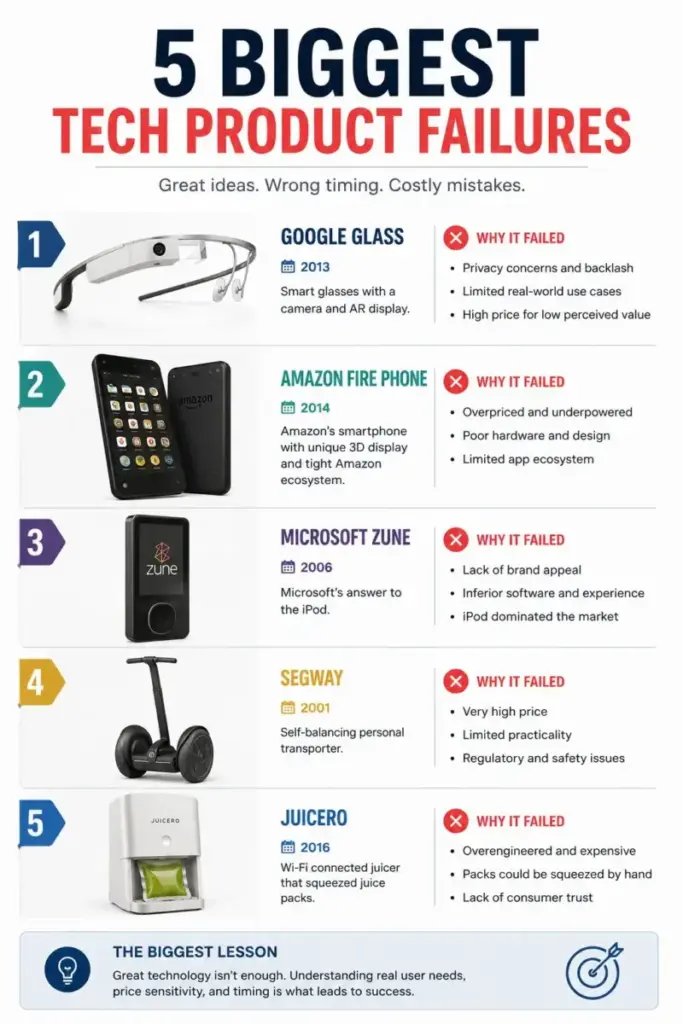
1. Google Glass: The Future Nobody Asked For
When Google introduced Google Glass in 2013, it felt like a glimpse into the future.
The wearable device could display notifications, provide navigation directions, take photos, record videos, and respond to voice commands. Many experts predicted augmented reality would become the next major computing platform.
Google launched the Explorer Edition for approximately $1,500 and generated enormous media attention.
Yet mainstream consumers never embraced it.
Why It Failed
Privacy concerns were the most visible problem.
People felt uncomfortable interacting with someone who could potentially record them without permission.
But privacy wasn’t the only issue.
Google Glass also suffered from a weak value proposition.
Consumers understood what the device did.
They didn’t understand why they needed it.
The product faced several additional obstacles:
- High price
- Limited battery life
- Few practical use cases
- Social stigma
- Unfinished user experience
Some businesses even banned the device.
What Happened Next?
Google eventually ended its consumer-focused efforts and shifted Glass toward enterprise applications.
In manufacturing, logistics, and industrial environments, workers could benefit from hands-free access to information.
The technology found a niche where its advantages were obvious.
Key Lesson
Being ahead of your time isn’t always an advantage.
If customers can’t immediately understand a product’s value, adoption becomes an uphill battle.
2. Microsoft’s Zune: A Good Product in the Wrong Battle
Microsoft launched the Zune in 2006 to challenge Apple’s iPod.
The problem?
It wasn’t actually competing against the iPod.
It was competing against Apple’s entire ecosystem.
Many reviewers liked the Zune. Some users preferred its interface and appreciated features like wireless music sharing.
Yet sales never approached iPod levels.
What Microsoft Misunderstood
By the time Zune arrived, Apple had already created a seamless experience combining:
- iPod hardware
- iTunes software
- Music purchases
- Device synchronization
- Customer loyalty
Consumers weren’t buying MP3 players.
They were buying convenience.
Switching to Zune meant leaving an ecosystem people already trusted.
The improvements simply weren’t significant enough to justify the switch.
What Happened Next?
Although Microsoft eventually discontinued the Zune, many technology enthusiasts still praise its design.
Elements of its interface later influenced other Microsoft products.
Key Lesson
The best product doesn’t always win.
The strongest ecosystem often does.
3. Amazon Fire Phone: A $170 Million Reality Check
Amazon’s Fire Phone remains one of the most expensive product failures in recent technology history.
The company hoped to repeat the success it achieved with Kindle devices.
The smartphone featured:
- Dynamic Perspective 3D effects
- Firefly object recognition
- Deep Amazon integration
- Multiple front-facing sensors
The technology was impressive.
Customers weren’t impressed.
Why It Failed
Amazon focused heavily on innovative features.
Customers focused on practical value.
The smartphone market was already dominated by Apple and Samsung, and consumers expected:
- Great cameras
- Large app ecosystems
- Reliable performance
- Smooth user experiences
The Fire Phone struggled to deliver compelling advantages in these areas.
Many consumers saw it as a shopping tool rather than a serious smartphone competitor.
Within months, Amazon reported a $170 million charge related largely to the device’s poor performance.
The Silver Lining
Some technologies and expertise developed during the project later contributed to Amazon’s broader AI and voice ecosystem.
Key Lesson
Customers don’t buy features.
They buy outcomes.
Innovation without customer value rarely succeeds.
4. Segway: The Revolution That Never Arrived
Before its launch, the Segway generated extraordinary hype.
Some investors and commentators predicted it would reshape cities, reduce traffic, and revolutionize transportation.
The technology worked exactly as advertised.
The market simply didn’t care enough.
Why It Failed
The Segway faced a simple question:
Why do I need this?
Walking was free.
Cycling was cheaper.
Driving was faster.
Public transportation was more practical.
The product occupied an awkward middle ground that appealed to relatively few consumers.
Additional challenges included:
- High cost
- Regulatory restrictions
- Infrastructure limitations
- Storage concerns
The Real Miscalculation
Segway’s creators assumed cities and consumers would adapt to the product.
Successful products usually do the opposite.
They adapt to existing customer behavior.
Smartphones fit naturally into everyday life.
The Segway required people to change their habits first.
That’s a difficult sell.
Key Lesson
If customers don’t feel the problem strongly enough, they won’t pay for the solution.
5. Juicero: Silicon Valley’s Most Famous Overengineered Product
Few startup failures have become as legendary as Juicero.
The company raised more than $100 million and marketed itself as the future of healthy living.
Its flagship product was a connected juicing machine that used proprietary juice packets.
The machine looked sleek.
The branding was excellent.
Investors were excited.
Then reality arrived.
The Discovery That Changed Everything
Consumers discovered they could squeeze the juice packets by hand.
No machine required.
Suddenly, the product’s value proposition collapsed.
People began asking a devastating question:
Why spend hundreds of dollars on a machine that performs a task your hands can already accomplish?
The company never found a convincing answer.
Why Juicero Became a Business School Case Study
Juicero became a symbol of a broader Silicon Valley problem:
Overengineering simple issues.
The company focused heavily on technological sophistication without proving that customers actually needed the solution.
Many entrepreneurs still study Juicero because it demonstrates the dangers of building technology before validating demand.
Key Lesson
Always validate the problem before building the solution.
The most sophisticated product in the world cannot succeed if the underlying problem isn’t important enough.
The Product-Market Fit Trap
Venture capitalist Marc Andreessen famously argued that product-market fit is one of the most important drivers of startup success.
In simple terms:
A product succeeds when it enters a market with strong demand and solves a meaningful problem.
Looking at these failures, a clear pattern emerges.
| Failure Type | Example |
|---|---|
| Solution looking for a problem | Juicero |
| Market not ready yet | Google Glass |
| Failed to justify switching costs | Zune, Fire Phone |
| Didn’t fit customer behavior | Segway |
Technology alone doesn’t create demand.
Customer demand creates demand.
Lessons at a Glance
| Product | Biggest Mistake | Business Lesson |
|---|---|---|
| Google Glass | Unclear value proposition | Timing and customer readiness matter |
| Zune | Ignored ecosystem power | Ecosystems often beat products |
| Fire Phone | Focused on features | Solve real customer problems |
| Segway | Didn’t fit user behavior | Adapt to existing habits |
| Juicero | Solved a weak problem | Validate demand first |
What Modern Businesses Can Learn
Before launching a new product, ask:
- Does this solve a meaningful problem?
- Is demand already visible?
- Can customers explain its value in one sentence?
- Is the pricing reasonable?
- Is switching worth the effort?
- Have we tested demand before scaling?
Many famous failures could have been prevented by answering these questions honestly.
Final Thoughts
The biggest technology failures in history weren’t caused by a lack of intelligence, funding, or ambition.
Google had world-class engineers.
Microsoft had enormous resources.
Amazon had one of the strongest brands in the world.
Juicero had investor backing.
Segway had innovative technology.
Yet all of them made the same mistake.
They overestimated technology and underestimated customer behavior.
That’s the enduring lesson behind every great product failure.
Technology matters.
Innovation matters.
But customer value matters most.
The companies that understand that distinction create products people don’t just admire.
They create products people actually use.
Frequently Asked Questions
What is the biggest tech product failure of all time?
Google Glass, Amazon Fire Phone, Microsoft Zune, Segway, and Juicero are frequently cited among the most famous technology product failures.
Why do innovative products fail?
Most innovative products fail because they lack product-market fit, arrive at the wrong time, are overpriced, or solve problems customers don’t consider important.
What was Google’s biggest failed product?
Google Glass is often considered one of Google’s most notable consumer product failures, although the technology later found enterprise applications.
What was Amazon’s biggest product failure?
Many analysts consider the Fire Phone Amazon’s biggest hardware failure because of its poor sales performance and the reported $170 million charge.
Why do startups struggle with product-market fit?
Many startups focus on building products before validating whether enough customers actually want them.
Can failed products influence future innovation?
Yes. Many failed products introduce ideas and technologies that later inspire successful innovations in other industries.
What is product-market fit?
Product-market fit occurs when a product successfully satisfies strong market demand and solves a meaningful customer problem.
Sources
- Amazon Q3 2014 Earnings Report
- Google Glass Explorer Program Announcements
- Marc Andreessen’s writings on Product-Market Fit
- Historical reporting from major technology and business publications
- Public company disclosures and industry case studies
Read related articles :