

Discover Tesla Robotaxi (Cybercab) in 2026. Learn how it works, pricing, safety, availability, Tesla vs Waymo, and the future of driverless rides.
Imagine opening an app, requesting a ride, and watching a vehicle pull up with nobody behind the wheel.
No driver.
No steering wheel.
No pedals.
Just a vehicle powered by artificial intelligence.
A few years ago, that idea sounded like science fiction. Today, it’s happening on public roads.
Tesla’s Robotaxi service and purpose-built Cybercab represent one of the most ambitious transportation projects of the decade. The company believes autonomous vehicles could eventually make transportation cheaper, safer, and more convenient while reducing the need for personal car ownership.
But there’s also plenty of skepticism.
Can Tesla’s technology handle real-world driving?
Will regulators allow large-scale deployment?
And is Tesla actually ahead of competitors like Waymo?
Let’s break down where Tesla Robotaxi stands in 2026 and what it could mean for the future of transportation.
What Is Tesla Robotaxi?
Quick Answer
Tesla Robotaxi is an autonomous ride-hailing service that uses self-driving Tesla vehicles to transport passengers without a human driver.
The long-term vision centers around the Cybercab, Tesla’s purpose-built autonomous vehicle that eliminates traditional driving controls entirely.
Instead of driving yourself or booking a ride from a human driver, you simply request transportation through an app and let the vehicle do the rest.
Think of it as combining:
- Ride-hailing
- Artificial intelligence
- Electric vehicles
into a single transportation platform.
What Is the Tesla Cybercab?
The Cybercab is Tesla’s first vehicle designed specifically for autonomous transportation.
Unlike current Tesla models, the Cybercab has:
- No steering wheel
- No pedals
- Two-passenger seating
- Wireless charging capability
- Fully autonomous operation
Tesla unveiled the vehicle as part of its vision for a future Robotaxi network.
The concept is simple.
If a car can drive itself safely, there’s no longer a need to design it around a human driver.
That allows Tesla to rethink everything from interior space to operating costs.
Why Tesla Is Betting Big on Robotaxis
Tesla’s Robotaxi strategy begins with a simple observation:
Most cars spend roughly 95% of their lives parked.
Think about your own vehicle.
It’s parked overnight.
Parked during work.
Parked while you’re shopping.
Parked while you’re at dinner.
Yet ownership costs never stop.
You still pay for:
- Insurance
- Maintenance
- Registration
- Parking
- Depreciation
Tesla believes Robotaxis could dramatically improve vehicle utilization.
Instead of sitting idle, autonomous vehicles could operate throughout the day, transporting passengers and generating revenue.
Transportation economists often call this shift “mobility as a service.”
Instead of owning transportation, you simply buy transportation when needed.
If that vision succeeds, Robotaxis could eventually become one of Tesla’s largest businesses.
Tesla Robotaxi Timeline: From Vision to Reality
| Year | Milestone |
|---|---|
| 2016 | Tesla begins promoting autonomous driving ambitions. |
| 2019 | Elon Musk outlines plans for a future Robotaxi network. |
| 2020–2023 | Full Self-Driving software expands through testing programs. |
| 2024 | Tesla unveils the Cybercab concept. |
| 2025 | Early Robotaxi testing expands. |
| 2026 | Tesla launches Robotaxi operations in Texas and expands service areas. |
| Future | Potential nationwide and international expansion. |
The timeline highlights an important point:
Robotaxis are not a new idea. They represent nearly a decade of Tesla’s autonomous driving strategy.
Where Is Tesla Robotaxi Available in 2026?
One of the biggest misconceptions is that Robotaxi remains purely a future concept.
That’s no longer true.
Tesla has begun operating Robotaxi services in parts of Texas, particularly around Austin, while continuing to pursue broader expansion.
However, deployment remains limited.
Unlike traditional ride-sharing services, Robotaxis cannot simply launch everywhere overnight.
Expansion depends on:
- Regulatory approval
- Safety validation
- Infrastructure readiness
- Operational testing
- Public acceptance
The challenge isn’t building autonomous vehicles.
The challenge is deploying them safely at scale.
How Tesla Robotaxi Technology Works
Tesla’s Robotaxi system combines:
- Cameras
- Neural networks
- Artificial intelligence
- Full Self-Driving software
These technologies allow vehicles to:
- Detect objects
- Recognize road signs
- Monitor traffic
- Navigate intersections
- Plan routes
- Respond to hazards
All without human intervention.
Why Tesla’s Camera-Only Strategy Is So Controversial
This is arguably the most important debate in autonomous driving.
Many self-driving companies rely on:
- Lidar
- Radar
- Cameras
- High-definition maps
Tesla takes a different approach.
The company primarily relies on cameras and AI.
Tesla’s argument is simple:
Humans drive using vision.
Therefore, advanced AI should eventually be able to drive using vision as well.
Critics disagree.
Many autonomous vehicle experts argue additional sensors provide valuable backup information during:
- Heavy rain
- Fog
- Darkness
- Complex road conditions
This disagreement has become one of the defining battles in the Robotaxi industry.
If Tesla succeeds, camera-based autonomy could dramatically lower deployment costs.
If it fails, competitors will argue that sensor redundancy was essential all along.
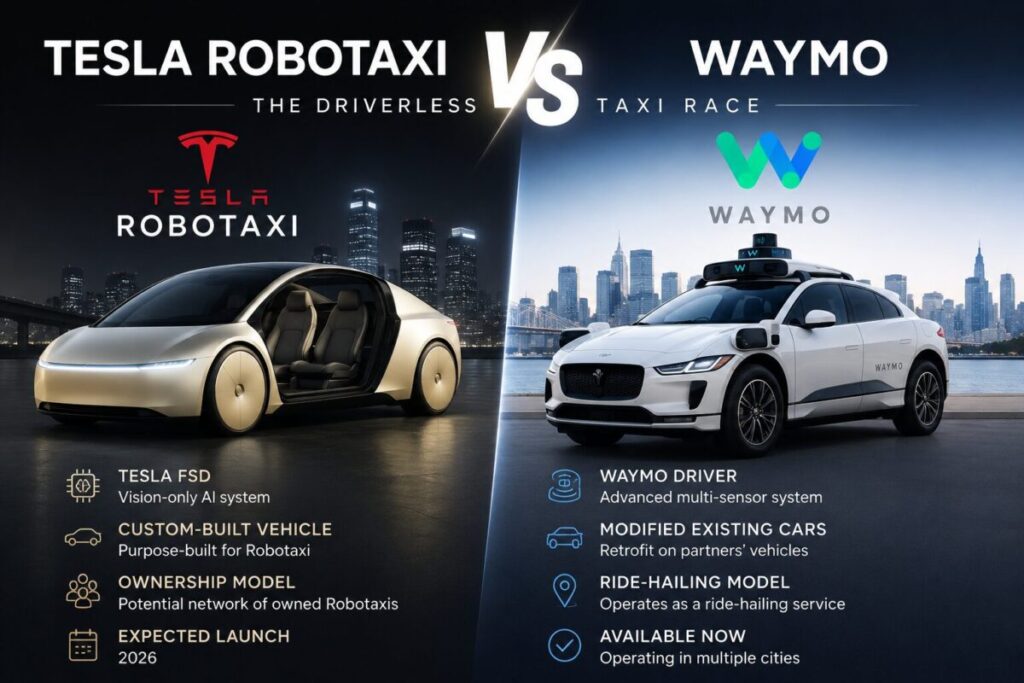
Tesla vs Waymo: Which Company Is Ahead?
Both Tesla and Waymo are trying to solve the same problem.
But they’re taking very different paths.
Tesla vs Waymo Comparison
| Category | Tesla Robotaxi | Waymo |
| Parent Company | Tesla | Alphabet |
| Main Technology | Cameras + AI | Lidar + Radar + Cameras |
| Vehicle Data Source | Millions of Tesla Vehicles | Dedicated Autonomous Fleet |
| Driverless Operations | Limited Rollout | Multiple U.S. Cities |
| Hardware Cost | Lower | Higher |
| Mapping Dependence | Lower | Higher |
| Scalability Potential | Very High | Moderate |
| Core Strategy | Vision-Based AI | Sensor Redundancy |
Looking at the table, the real difference becomes clear.
Waymo focuses on building the safest possible autonomous system today.
Tesla focuses on building a system that can eventually scale globally.
Waymo currently has the advantage in commercial driverless operations.
Tesla’s advantage lies in its enormous connected vehicle fleet and data collection network.
The winner may ultimately be the company that balances safety, scalability, and economics most effectively.
What Riding in a Tesla Robotaxi Might Feel Like
Imagine you have an early morning flight.
You request a Robotaxi.
A vehicle arrives.
The doors unlock automatically.
You enter your destination.
Then something unusual happens.
Nothing.
No driver.
No small talk.
No concerns about navigation.
The vehicle simply takes you where you need to go.
For some people, that sounds incredibly convenient.
For others, it sounds slightly unsettling.
That’s why public trust remains one of the biggest challenges facing autonomous transportation.
How Much Could Tesla Robotaxi Cost?
Tesla hasn’t announced long-term pricing.
However, the economic argument is straightforward.
Removing the driver eliminates one of the largest expenses in transportation.
Potential savings include:
- No driver wages
- Lower energy costs
- Higher vehicle utilization
- Automated dispatching
- Reduced downtime
Example
A commuter traveling 15 miles each way to work currently pays for:
- Vehicle financing
- Insurance
- Fuel
- Maintenance
- Parking
A mature Robotaxi network could potentially reduce many of those costs by turning transportation into an on-demand service.
Could Tesla Owners Earn Money From Robotaxis?
Tesla has long discussed allowing eligible owners to add their vehicles to a future Robotaxi network.
Imagine your car generating income while you’re at work.
Or while you’re asleep.
It’s an attractive concept.
But several challenges remain:
- Regulation
- Insurance
- Liability
- Fleet management
- Autonomous reliability
The idea remains one of Tesla’s most intriguing long-term opportunities.
Why Regulators Are Moving Slowly
Even if the technology advances rapidly, regulation often moves much slower.
Government agencies must answer difficult questions.
For example:
- How safe are Robotaxis?
- Who is liable after an accident?
- How should autonomous vehicles be insured?
- What reporting requirements should apply?
These questions have no simple answers.
That’s why Robotaxi deployment continues to expand city by city rather than nationwide.
What Happens If a Robotaxi Crashes?
This remains one of the most important unresolved issues.
In traditional accidents, responsibility usually falls on one or more drivers.
Robotaxis complicate that model.
Potentially responsible parties could include:
- Vehicle manufacturers
- Software developers
- Fleet operators
- Other road users
As autonomous transportation expands, legal frameworks will continue evolving alongside the technology.
Could Robotaxis Replace Car Ownership?
For some people, the answer may eventually be yes.
If Robotaxis become:
- Affordable
- Reliable
- Safe
- Widely available
Many urban residents may decide they no longer need a personal vehicle.
The transition could mirror what happened in entertainment when streaming services replaced DVD collections.
Ownership became less important because access became easier.
Transportation may follow a similar path.
Final Verdict
Whether Tesla ultimately wins the Robotaxi race remains uncertain.
What is becoming increasingly clear, however, is that autonomous transportation is no longer a distant concept.
It’s already operating on public roads.
It’s already carrying passengers.
And it’s already forcing the automotive industry to rethink what a vehicle can be.
The next few years may determine not only Tesla’s future, but the future of transportation itself.
Frequently Asked Questions
Is Tesla Robotaxi available in California?
Availability depends on local regulatory approvals and deployment plans. Expansion continues market by market.
Can you buy a Tesla Cybercab?
Tesla’s vision centers on autonomous transportation services, though future ownership options remain unclear.
Does Tesla Robotaxi use Full Self-Driving?
Yes. Tesla’s Robotaxi platform relies on the company’s Full Self-Driving technology and AI systems.
Is Tesla Robotaxi cheaper than Uber?
Tesla expects autonomous rides to eventually cost less because Robotaxis eliminate driver-related expenses.
How is Tesla different from Waymo?
Tesla primarily relies on cameras and AI, while Waymo uses lidar, radar, cameras, and detailed maps.
Could Robotaxis replace personal car ownership?
For many urban residents, autonomous transportation could eventually become a practical alternative to owning a vehicle.
Read related article : What Is Elon Musk’s Starlink? How Space-Based Internet Is Challenging Traditional Broadband