

Tesla Model Y vs Rivian R2 are set for a major showdown in 2026. Compare the Rivian R2 and Tesla Model Y on price, range, charging, ownership costs, and real-world value.
For years, Tesla didn’t just lead the EV market. In many ways, it defined it.
The Tesla Model Y became the benchmark for electric SUVs because it combined long range, practical utility, software innovation, and the industry’s most reliable charging network. Even buyers who weren’t passionate about Tesla often ended up choosing one because it simply made EV ownership easier.
That may finally be changing.
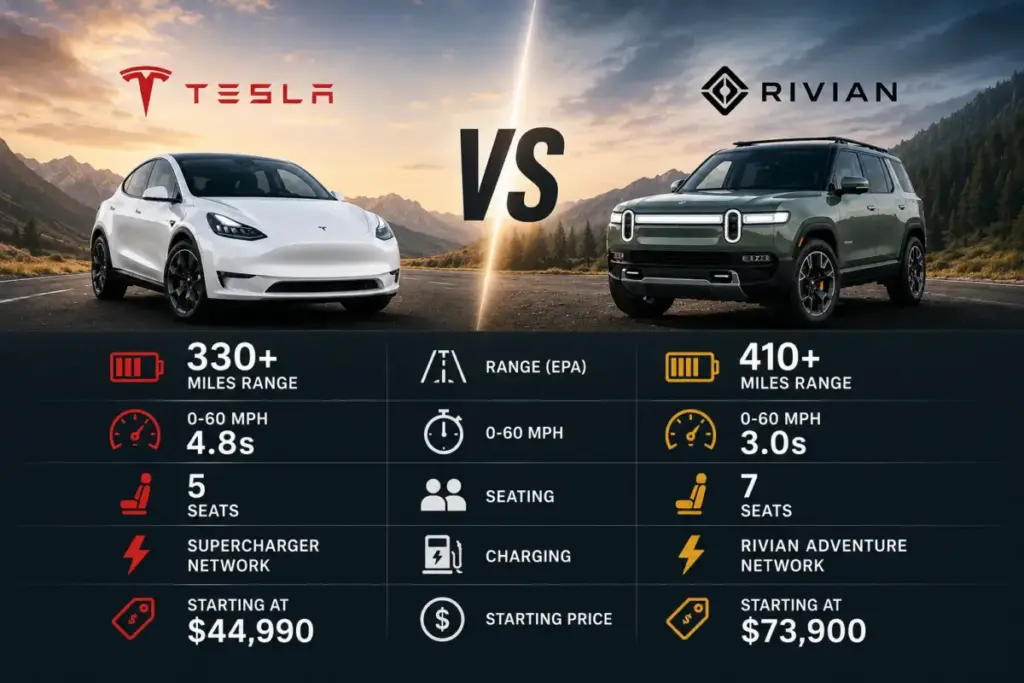
The Rivian R2 is the first vehicle from Rivian designed specifically for the mainstream market. With a starting price around $45,000, projected range of up to 345 miles, and access to Tesla’s charging standard, the R2 is aimed directly at buyers who would normally consider a Model Y.
This comparison uses manufacturer specifications, independent testing data, industry reporting, and EV market trends available as of June 2026.
The goal isn’t to determine which vehicle has the longest specification sheet.
It’s to answer the question most buyers actually care about:
Which electric SUV offers the better ownership experience in 2026?
Quick Verdict
If you’re buying your first EV today, the Tesla Model Y remains the safer recommendation.
Tesla still leads in charging infrastructure, software maturity, ownership history, and resale value.
However, the Rivian R2 appears to offer something Tesla hasn’t faced in years: a credible competitor with a clear identity.
Tesla may build the easier EV to own.
Rivian may build the more interesting one.
That’s what makes this comparison so important.
Why the Tesla Model Y vs Rivian R2 Battle Matters
The future of the EV market won’t be decided by six-figure luxury vehicles.
It will be decided by practical electric SUVs that everyday families can afford.
That’s exactly why the Rivian R2 matters.
Industry analysts increasingly point to the $40,000-$55,000 SUV segment as the next major battleground for EV adoption. This is where first-time EV buyers shop, where families compare monthly payments, and where automakers have the greatest opportunity to convert gasoline vehicle owners.
For Rivian, the R2 is more than a new model.
It’s a chance to become a mainstream automotive brand.
For Tesla, it’s the first time in years that a new EV enters the market with a realistic chance of pulling buyers away from the Model Y.
Rivian R2: Why Industry Experts Are Paying Attention
Rivian’s first vehicles, the R1T and R1S, proved the company could build desirable electric vehicles.
The challenge was affordability.
Most buyers simply weren’t prepared to spend more than $70,000 on an EV.
The R2 changes that equation.
Expected Rivian R2 Specifications
- Starting price around $45,000
- Up to 345 miles of estimated range
- Five-passenger seating
- NACS charging compatibility
- Up to 90.1 cubic feet of cargo capacity
- Advanced driver-assistance systems
- Over-the-air software updates
- Adventure-focused design
Those specifications place the R2 directly in Tesla Model Y territory rather than the premium EV segment.
If Rivian executes successfully, the R2 could become the company’s breakthrough product.
Tesla’s Biggest Strength Isn’t Range. It’s Convenience.
Many shoppers assume Tesla’s biggest advantage is range.
Others point to acceleration.
Neither is the real story.
Tesla’s greatest strength is convenience.
The company spent more than a decade building an ecosystem around its vehicles.
That ecosystem includes:
- Global Supercharger access
- Integrated route planning
- Mature smartphone integration
- Frequent software updates
- Extensive ownership data
- Established service infrastructure
Tesla’s Supercharger network now includes tens of thousands of charging connectors worldwide.
That number matters because charging availability often influences ownership satisfaction more than performance figures.
An EV with slightly less range but easier charging is often the better vehicle to own.
This remains Tesla’s biggest advantage.
Tesla Model Y vs Rivian R2: Which Vehicle Wins Where?
| Buyer Priority | Winner | Why |
|---|---|---|
| Road Trips | Tesla Model Y | Larger charging network and trip planning |
| Outdoor Adventures | Rivian R2 | Utility-focused design and lifestyle features |
| Charging Convenience | Tesla Model Y | More mature charging ecosystem |
| Cargo Flexibility | Rivian R2 | Adventure-oriented storage solutions |
| Software Experience | Tesla Model Y | More established software platform |
| First EV Purchase | Tesla Model Y | Easier ownership experience |
| Standing Out | Rivian R2 | Less common and more distinctive |
| Family Practicality | Tie | Both offer strong everyday usability |
| Proven Reliability | Tesla Model Y | Longer ownership history |
| Future Potential | Rivian R2 | Significant growth opportunity |
Price Comparison: What Buyers Should Really Compare
The Rivian R2’s $45,000 starting price generated headlines for a reason.
It places Rivian within reach of mainstream buyers.
However, shoppers should remember that starting prices rarely tell the full story.
Higher-end launch trims may cost considerably more, while Tesla frequently adjusts pricing based on production costs and market conditions.
What Smart Buyers Compare
Instead of focusing solely on MSRP, compare:
- Insurance premiums
- Financing costs
- Charging expenses
- Maintenance requirements
- Tax incentives
- Expected depreciation
The cheapest vehicle upfront isn’t always the cheapest vehicle to own.
Real Ownership Costs: The Overlooked EV Comparison
This is where many buying guides fall short.
The real cost of ownership extends far beyond the purchase price.
Tesla Model Y Ownership Advantages
- Larger service network
- Proven resale value
- Broad parts availability
- Extensive charging infrastructure
Potential Rivian R2 Ownership Advantages
- Competitive starting price
- Potentially lower entry cost
- Strong utility value
- Unique market positioning
Costs Both Buyers Should Consider
- Home charger installation
- Insurance rates
- Tire replacement
- Registration fees
- Charging costs
- Vehicle depreciation
Over a five-year ownership period, these expenses can easily exceed the difference between vehicle purchase prices.
Range and Efficiency: The Metric Most Buyers Overestimate
Range anxiety receives enormous attention.
Actual ownership data tells a different story.
Most drivers travel far less than 100 miles per day.
For many owners, charging convenience becomes more important than maximum range.
Rivian R2
Expected highlights include:
- Up to 345 miles of range
- Fast charging capability
- Single and dual motor configurations
Tesla Model Y
Current strengths include:
- Excellent efficiency
- Mature battery management
- Consistent real-world performance
Winner
Tesla maintains a slight advantage.
Not because the range difference is huge, but because its charging ecosystem makes those miles easier to use.
Ownership Experience: Where Spec Sheets Stop Mattering
Specifications sell vehicles.
Ownership experiences create loyalty.
Tesla Owners Commonly Praise
- Charging convenience
- Strong software support
- Excellent route planning
- Frequent feature updates
Common Tesla Complaints
- Service delays in some regions
- Minimalist interior design
- Build-quality concerns reported by some owners
Rivian Owners Commonly Praise
- Premium cabin materials
- Clever storage solutions
- Distinctive design
- Outdoor-focused practicality
Common Rivian Complaints
- Smaller service footprint
- Less mature support network
- Limited long-term ownership data
These factors rarely appear in advertisements, but they often matter most after purchase.
Should Current Tesla Owners Switch to the Rivian R2?
This may be the most interesting question in the entire comparison.
For years, Tesla owners had few alternatives that offered a meaningful advantage.
The Rivian R2 changes that.
Tesla Owners May Prefer the R2 If:
- They spend significant time outdoors
- They want more utility-focused design
- They want something less common
- They appreciate Rivian’s brand identity
Tesla Owners Should Probably Stay With Tesla If:
- They frequently take long road trips
- They rely heavily on Superchargers
- They prioritize software integration
- They value a proven ownership ecosystem
For many Tesla owners, the R2 won’t be an automatic replacement.
But it may be the first EV in years that deserves serious consideration.
What We Still Don’t Know About the Rivian R2
One reason Tesla remains the safer recommendation is simple:
We have years of Model Y ownership data.
We don’t have that for the R2.
Important unanswered questions include:
- Final EPA ratings
- Long-term reliability
- Cold-weather performance
- Insurance costs
- Depreciation trends
- Service network scalability
- Real-world efficiency
These uncertainties don’t make the R2 a risky purchase.
They simply highlight the difference between an established platform and a brand-new one.
The Bigger EV Market Trend
The Tesla vs Rivian debate represents something larger.
The next wave of EV growth won’t come from luxury buyers.
It will come from families replacing gasoline SUVs.
That’s why the R2 matters.
It isn’t just competing with Tesla.
It’s competing with the Toyota RAV4, Honda CR-V, Ford Escape, and countless other mainstream vehicles.
If Rivian succeeds, it could accelerate EV adoption across the broader market.
Pros and Cons at a Glance
Rivian R2 Pros
- Distinctive styling
- Adventure-focused utility
- Strong projected range
- Competitive starting price
- NACS charging compatibility
Rivian R2 Cons
- New platform
- Limited ownership history
- Smaller service network
- Unknown long-term resale performance
Tesla Model Y Pros
- Massive charging ecosystem
- Proven ownership experience
- Strong resale value
- Mature software platform
- Available today
Tesla Model Y Cons
- Common appearance
- Less adventurous character
- Interior design may not appeal to everyone
Final Verdict
If a friend asked me which electric SUV to buy tomorrow, I’d recommend the Tesla Model Y.
Not because it’s the most exciting vehicle.
Because it’s currently the most complete ownership package.
Tesla’s charging infrastructure, software ecosystem, and ownership history reduce many of the uncertainties that still concern EV buyers.
However, that’s exactly why the Rivian R2 is so intriguing.
For the first time in years, Tesla isn’t facing another startup trying to imitate its formula.
It’s facing a competitor with a different vision of what an electric SUV should be.
The Tesla Model Y remains the benchmark.
The Rivian R2 may become the vehicle that finally forces Tesla to defend that title.
Sources
- Rivian R2 Official Specifications
- Tesla Model Y Specifications
- Edmunds EV Testing Data
- Kelley Blue Book EV Ownership Research
- Business Insider EV Industry Coverage
- Autoweek Vehicle Launch Reports
- Public EV Charging Infrastructure Reports
Frequently Asked Questions
Is the Rivian R2 better than the Tesla Model Y?
Not necessarily. The Model Y remains the safer ownership choice, while the R2 appears more appealing for buyers seeking adventure-focused utility and distinctive design.
What is the expected Rivian R2 price?
Rivian has targeted a starting price around $45,000, though launch trims may cost more.
What is the Rivian R2 release date?
Current plans point to a 2026 launch, though timelines can change.
Can Rivian R2 owners use Tesla Superchargers?
Yes. Rivian has adopted Tesla’s North American Charging Standard (NACS).
Which electric SUV is better for road trips?
The Tesla Model Y currently has the advantage because of its charging network and route-planning software.
Will the Rivian R2 qualify for EV tax credits?
Eligibility depends on federal regulations, battery sourcing requirements, and buyer qualifications.
Is Rivian financially stable enough for long-term ownership?
Rivian continues investing heavily in manufacturing expansion and future vehicle programs, though it remains much earlier in its growth journey than Tesla.
Is the Rivian R2 a good Tesla Model Y alternative?
Yes. It is arguably the strongest direct Model Y competitor Rivian has produced and one of the most anticipated affordable EV SUVs of 2026.
Read related articles: