

Discover how BMW new color-changing car uses E-Ink technology to transform vehicle design. Learn how BMW E-Ink technology works, its benefits, challenges, and future production plans in 2026.
For more than 100 years, choosing a car’s color has been a permanent decision.
You pick a shade at the dealership, drive the vehicle home, and that color stays with the car for the next decade or more.
BMW believes that model is outdated.
In a world where smartphones update overnight, software unlocks new vehicle features, and digital experiences constantly evolve, the German automaker is asking a surprisingly simple question:
Why should a car’s appearance remain fixed?
That question has led BMW down one of the automotive industry’s most ambitious technology projects: a vehicle capable of changing its color electronically using E-Ink technology.
What started as a futuristic CES concept has evolved into something much more serious. In 2026, BMW’s latest demonstrations suggest the company is no longer trying to prove the technology works.
It already has.
The challenge now is proving that drivers actually need it.
And that may be the harder task.
The Short Answer: BMW’s Color-Changing Technology Is Real
If you’ve seen videos of BMW’s color-changing vehicles and wondered whether they were genuine, the answer is yes.
The technology is real, functional, and significantly more advanced than it was just a few years ago.
In 2022, BMW’s iX Flow concept could switch between black and white.
By 2023, the BMW i Vision Dee expanded that capability to 32 colors across 240 individually controlled E-Ink segments.
In just four years, BMW transformed a two-color demonstration into a programmable exterior surface capable of displaying complex visual effects and dynamic patterns.
That’s a remarkable pace of development.
The bigger question is whether the technology can make the jump from concept vehicle to production car.
From Publicity Stunt to Serious Engineering Project
When BMW unveiled the iX Flow at CES 2022, reactions were mixed.
Some people were impressed.
Others saw it as little more than a clever marketing exercise.
That skepticism wasn’t unreasonable.
Automotive history is filled with futuristic concepts that generated headlines before quietly disappearing.
At the time, many observers struggled to see the practical value of a car that could switch between black and white.
BMW kept developing the idea anyway.
The turning point came with the i Vision Dee concept.
The technology no longer looked like a novelty feature.
Instead, it began to resemble a platform.
A programmable exterior.
A digital surface.
A new way of thinking about automotive design.
That shift changed the conversation.
Today, BMW’s engineers are focusing less on visual effects and more on the challenges that determine whether a technology survives in the real world:
- Long-term durability
- Manufacturing complexity
- Environmental resistance
- Cost efficiency
- Regulatory compliance
That’s what makes BMW’s 2026 demonstrations more significant than the original concepts.
The company is no longer asking, “Can we build it?”
It’s asking, “Can we mass-produce it?”
What’s New in BMW’s 2026 E-Ink Development?
This is where the story becomes particularly interesting.
Earlier prototypes focused heavily on demonstrating what was possible.
The latest development efforts appear focused on what is practical.
BMW’s current priorities include:
- Simplifying E-Ink integration
- Improving durability
- Reducing manufacturing complexity
- Enhancing weather resistance
- Moving closer to production-ready applications
Those improvements may sound less exciting than a car changing colors in seconds.
In reality, they are far more important.
Building a concept car is relatively easy.
Building a production vehicle that can survive ten years of rain, sunlight, road salt, and temperature extremes is an entirely different challenge.
That’s where BMW’s engineering effort is now concentrated.
How BMW’s E-Ink Technology Actually Works
The science behind the system is surprisingly elegant.
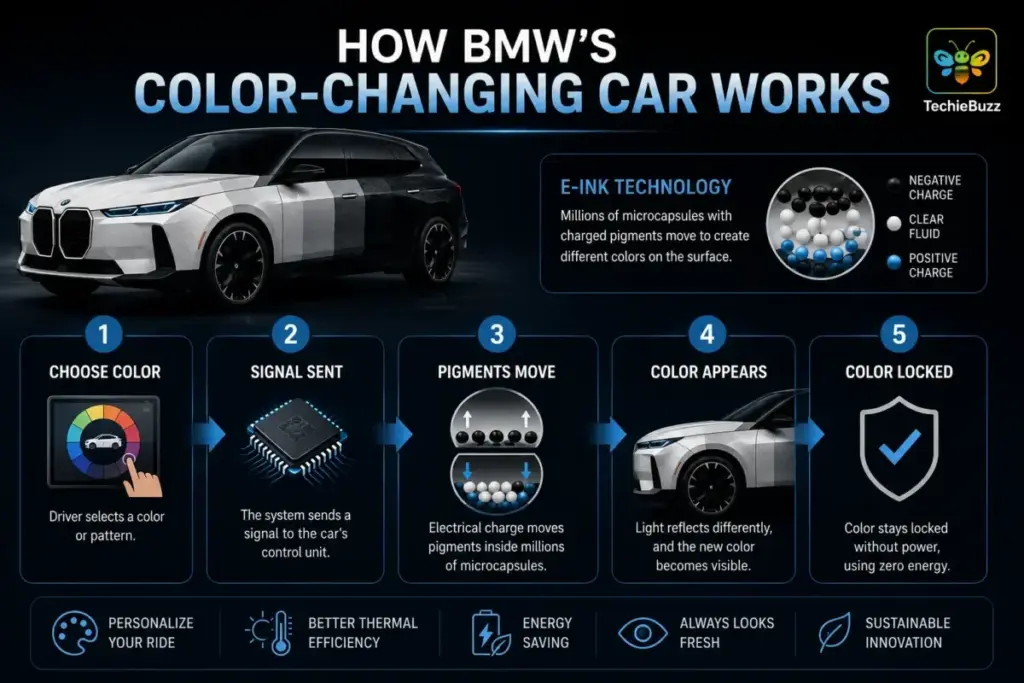
The vehicle’s exterior contains millions of microscopic microcapsules embedded within a specialized electronic layer.
Each capsule contains charged pigments suspended in a transparent fluid.
When electricity is applied, those pigments move.
As their position changes, the visible color changes too.
Unlike traditional screens, E-Ink doesn’t continuously emit light.
Instead, it physically rearranges pigments.
This creates two major advantages:
Extremely Low Power Consumption
E-Ink only requires electricity when changing appearance.
Once a color is selected, it remains visible without drawing constant power.
For electric vehicles, every efficiency gain matters.
High Visibility in Sunlight
Unlike many displays that become harder to see outdoors, E-Ink performs exceptionally well in bright conditions.
That’s one reason the technology has been successful in e-readers and why BMW sees potential for automotive applications.
The Biggest Misconception About BMW’s Color-Changing Car
Most people assume this technology is primarily about customization.
Ironically, customization may end up being the least important reason it succeeds.
The stronger business case may be efficiency.
Vehicle color affects heat absorption.
Dark surfaces absorb more solar energy.
Light surfaces reflect more heat.
That means a color-changing exterior could potentially help regulate vehicle temperatures.
On hot days, a lighter exterior could reduce cabin heat buildup.
During colder months, darker surfaces could absorb additional warmth.
Will this dramatically increase EV range?
Probably not.
But automotive innovation is often about incremental gains.
A one-percent improvement here.
A small efficiency gain there.
Over millions of vehicles, those improvements matter.
That’s why BMW continues investing in the technology despite the engineering complexity.
Why BMW Thinks Paint Is Due for an Upgrade
The automotive industry has spent decades improving almost every part of the driving experience.
Engines evolved.
Batteries evolved.
Software evolved.
Driver-assistance systems evolved.
Paint largely stayed the same.
BMW sees vehicle exteriors as one of the last static elements of modern automotive design.
The company’s broader vision is a vehicle that adapts to changing conditions rather than remaining fixed.
In that context, color-changing technology starts to make more sense.
It’s less about replacing paint.
It’s about making vehicle surfaces intelligent.
The Reality Check: Why Color-Changing Cars Could Still Fail
This is the part many articles ignore.
The technology is impressive.
That doesn’t guarantee success.
History is filled with innovations that worked perfectly but failed to solve problems consumers actually cared about.
BMW still faces several major challenges.
Durability
Traditional automotive paint can survive more than a decade of exposure to:
- UV radiation
- Rain
- Snow
- Road salt
- Dust
- Extreme temperatures
E-Ink surfaces must demonstrate similar reliability.
Until that happens, mass adoption remains unlikely.
Cost
Advanced materials remain expensive.
Even if the technology reaches production, it will likely appear first in premium vehicles.
The economics must eventually make sense for mainstream consumers.
Consumer Demand
This may be the biggest unknown.
Do drivers actually want a color-changing vehicle?
Or is it simply an interesting feature that generates attention?
BMW still needs to answer that question.
Regulations
Governments may eventually need to establish rules regarding:
- Color changes while driving
- Animated displays
- Dynamic vehicle surfaces
- Visibility requirements
Regulation often moves slower than innovation.
That could become another hurdle.
Why the Automotive Industry Is Watching Closely
BMW isn’t simply experimenting with a new type of paint.
The company is helping define what software-defined vehicles may look like in the future.
Modern cars already receive updates that improve:
- Navigation
- Battery management
- Performance
- Driver assistance
- Infotainment systems
BMW’s E-Ink technology extends that philosophy to the exterior itself.
If software can change how a vehicle drives, why shouldn’t software change how it looks?
That’s the bigger question BMW is trying to answer.
And it’s one reason competitors are paying attention.
Will BMW’s Color-Changing Technology Reach Production?
Nobody knows yet.
But the conversation has changed dramatically.
A few years ago, people questioned whether BMW could build a color-changing car at all.
Today, that question has been answered.
The technology works.
Now the debate revolves around commercialization.
Can BMW make it durable enough?
Affordable enough?
Useful enough?
Those answers will determine whether E-Ink becomes a niche experiment or one of the most important automotive design innovations of the next decade.
Final Thoughts
BMW has already achieved the easy part.
It proved a car can change its color.
The difficult part is proving why it should.
If the company can demonstrate meaningful benefits in efficiency, safety, and personalization, E-Ink technology could become far more than a conversation starter.
It could fundamentally change what we expect from a vehicle’s exterior.
But if the benefits remain mostly cosmetic, color-changing cars may join the long list of fascinating automotive concepts that never become mainstream.
Either way, BMW has already succeeded in challenging an assumption that most people never questioned:
That a car’s color should remain the same for its entire life.
And that alone makes the project worth watching.
Frequently Asked Questions
What is BMW iX Flow?
BMW iX Flow is the company’s first E-Ink concept vehicle, unveiled in 2022. It demonstrated the ability to switch between black and white using electronic ink technology applied to the vehicle’s exterior.
Can BMW’s color-changing car switch to any color?
Not currently. BMW’s most advanced demonstrations have showcased up to 32 colors and 240 individually controlled segments, but the technology does not yet offer unlimited color choices.
How does BMW’s E-Ink technology work?
The system uses millions of microscopic capsules containing charged pigments. Electrical signals move those pigments to create different colors and patterns on the vehicle’s surface.
Does E-Ink technology consume a lot of electricity?
No. E-Ink only requires power when changing appearance. Once a color is selected, it remains visible without continuous energy consumption.
Is BMW selling color-changing cars in 2026?
No. BMW continues developing the technology, but no production-ready model has been officially announced.
Could color-changing cars become mainstream?
Possibly. If automakers can solve challenges related to durability, cost, regulations, and consumer demand, adaptive vehicle surfaces could become a common feature in future vehicles.
Read related articles : Tesla Robotaxi (Cybercab) Explained: Everything You Need to Know in 2026