

Explore 10 future technologies that could reshape everyday life by 2030, including AI assistants, smart homes, AR glasses, wearable healthcare, renewable energy, and more.
LIFE IN 2030: Closer Than You Think
Imagine someone from 2010 waking up in 2026.
They’d see people talking to AI assistants, smartwatches monitoring heart health, electric vehicles on the road, and robots helping move products through warehouses.
To them, it would feel like science fiction.
Now imagine life just four years from today.
Could your home automatically adjust to your habits? Could wearable devices warn you about health problems before symptoms appear? Could AI handle tasks that currently take hours of your week?
The future isn’t arriving all at once. Some technologies on this list are already becoming part of daily life, while others are still evolving. Together, they offer a glimpse of how technology could reshape the way we live, work, travel, and stay healthy by 2030.
According to the World Economic Forum, technological change is expected to reshape millions of jobs and industries by the end of this decade. Companies worldwide are investing billions into artificial intelligence, healthcare innovation, renewable energy, robotics, and advanced computing.
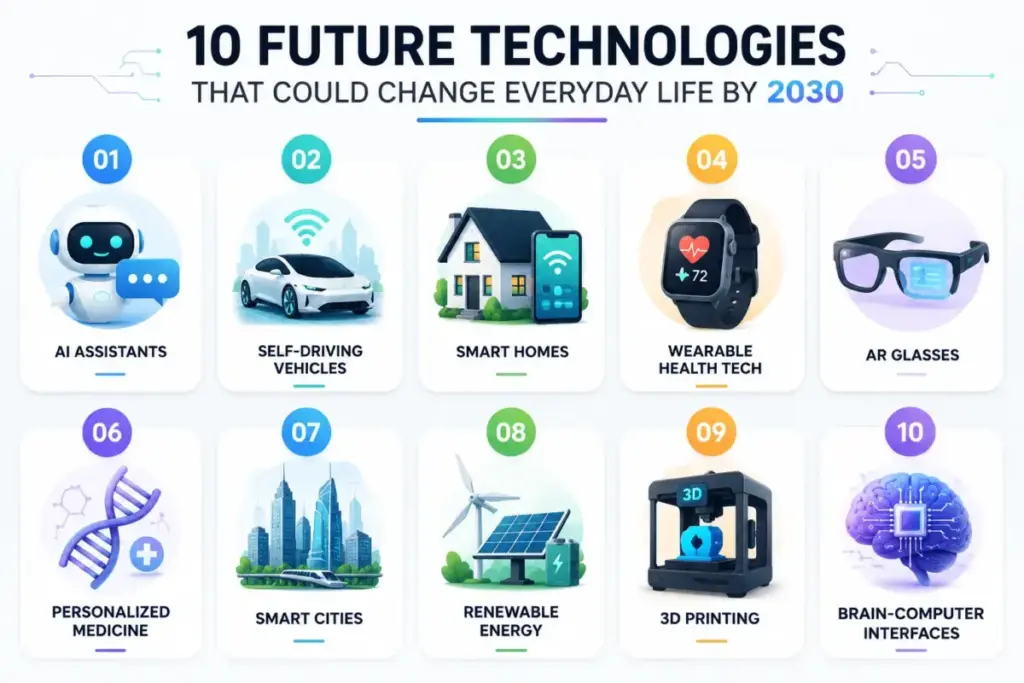
Future Technologies at a Glance
| Technology | Current Stage | Potential Impact by 2030 |
|---|---|---|
| AI Assistants | Rapid Growth | Very High |
| Self-Driving Vehicles | Limited Deployment | High |
| Smart Homes | Mainstream Growth | High |
| Wearable Health Tech | Expanding Fast | Very High |
| AR Glasses | Early Adoption | High |
| Personalized Medicine | Emerging | High |
| Smart Cities | Growing | High |
| Renewable Energy | Mainstream | Very High |
| 3D Printing | Expanding | Medium |
| Brain-Computer Interfaces | Experimental | Medium |
Let’s explore the technologies that could have the biggest impact on everyday life by 2030.
1. AI Assistants Will Become Everyday Teammates
AI has evolved far beyond answering simple questions.
Today, tools from OpenAI, Google, and Microsoft can write emails, summarize meetings, generate content, and assist with coding.
Microsoft CEO Satya Nadella has described AI as a “reasoning layer” that could transform how people work.
Imagine waking up and finding your AI assistant has already:
- Organized your schedule
- Ordered groceries
- Summarized important messages
- Suggested the fastest route to work
The biggest shift may not be smarter AI. It may be AI becoming so useful that it quietly handles everyday tasks in the background.
What This Means for You
Less time spent managing life and more time focusing on what matters.
2. Self-Driving Vehicles Could Give Us Time Back
Most discussions about autonomous vehicles focus on technology.
The real benefit may be time.
Companies like Waymo and Tesla continue developing self-driving systems, and driverless taxi services already operate in selected cities.
Human error contributes to most road accidents worldwide. Autonomous systems don’t get distracted, tired, or impaired.
Imagine spending your commute:
- Reading
- Working
- Watching a show
- Simply relaxing
Instead of concentrating on traffic.
What This Means for You
Safer transportation and potentially hours of free time every week.
3. Smart Homes Will Anticipate Your Needs
Today’s smart homes respond to commands.
Tomorrow’s smart homes may predict them.
Imagine arriving home after work and finding:
- The temperature already adjusted
- Lights set to your preference
- Security systems activated
- Household supplies automatically reordered
Industry forecasts suggest the smart home market could exceed $500 billion by 2030.
Companies such as Amazon, Google, and Apple are investing heavily in connected home ecosystems.
What This Means for You
More convenience, lower energy costs, and improved home security.
4. Wearable Technology Could Transform Healthcare
Healthcare has traditionally been reactive.
You feel sick, then seek treatment.
Future healthcare may become preventive.
Wearable devices are becoming increasingly capable of monitoring:
- Heart health
- Sleep quality
- Stress levels
- Blood pressure
- Blood glucose
Some smartwatches already alert users to irregular heart rhythms that may require medical attention.
Imagine receiving a warning weeks before a health issue becomes serious.
What This Means for You
Earlier detection, better health monitoring, and potentially longer, healthier lives.
5. AR Glasses Could Become the Next Smartphone
For nearly two decades, smartphones have dominated digital life.
The next major platform could be augmented reality glasses.
Companies such as Meta and Apple are investing heavily in AR technology.
Instead of looking down at a screen, information could appear directly in front of you.
Need directions?
Navigation appears in your field of view.
Traveling abroad?
Signs and menus translate instantly.
The smartphone succeeded because it put the internet in our pockets.
AR glasses could succeed by removing the pocket altogether.
What This Means for You
Faster access to information without constantly reaching for a phone.
6. Personalized Medicine Could Improve Treatment
Traditional medicine often relies on treatments designed for large groups.
Future healthcare may focus on individuals.
By combining:
- DNA analysis
- Medical history
- Lifestyle data
- Artificial intelligence
Doctors may be able to recommend highly personalized treatments.
Instead of asking:
“What works for most people?”
Healthcare may increasingly ask:
“What works best for this person?”
What This Means for You
More effective treatment and fewer unnecessary side effects.
7. Smart Cities Could Make Urban Life Easier
Nobody enjoys traffic jams, delayed transport, or inefficient public services.
Smart cities aim to address these challenges through sensors, connectivity, and AI.
Future systems may optimize:
- Traffic flow
- Public transportation
- Energy consumption
- Waste collection
- Emergency response
Cities like Singapore are already experimenting with intelligent urban infrastructure.
What This Means for You
Less congestion, cleaner streets, and more efficient city services.
8. Renewable Energy Could Become the Default Choice
Renewable energy is no longer a niche technology.
Solar and wind power continue to grow as costs fall and efficiency improves.
Battery technology is advancing rapidly, allowing homes and businesses to store energy more effectively.
Governments and private companies are investing billions into clean energy infrastructure.
What once seemed environmentally idealistic is increasingly becoming economically practical.
What This Means for You
Lower energy costs and greater energy independence.
9. 3D Printing Could Change Manufacturing
Imagine your washing machine breaks because of a small plastic part.
Instead of waiting days for a replacement, you download a design and print it at home.
That’s the promise of advanced 3D printing.
Applications are expanding into:
- Household products
- Medical devices
- Educational tools
- Custom manufacturing
As costs continue to fall, localized production could become far more common.
What This Means for You
Faster access to products and greater customization.
10. Brain-Computer Interfaces Could Redefine Human Potential
If one technology sounds like science fiction, it’s this one.
Brain-computer interfaces aim to create direct communication between the brain and digital devices.
Researchers have already demonstrated systems that allow people with paralysis to move computer cursors and communicate using only their thoughts.
Companies like Neuralink are pushing the field forward.
While mainstream adoption may take longer than 2030, the technology is advancing rapidly.
What This Means for You
New possibilities for accessibility, healthcare, and human-computer interaction.
Final Thoughts
If history has taught us anything, it’s that the technologies that change our lives most often arrive quietly.
Few people predicted how quickly smartphones, cloud computing, social media, and AI would become everyday tools.
Many technologies on this list already exist in early forms. Over the next few years, they’ll likely become faster, cheaper, and more accessible.
By 2030, some of these innovations may feel as ordinary as smartphones and Wi-Fi do today.
The future isn’t waiting for us at the end of the decade.
In many ways, it’s already here.
Frequently Asked Questions
What technology will have the biggest impact by 2030?
Artificial intelligence is expected to have the broadest impact because it affects healthcare, education, transportation, business, and everyday productivity.
Will AI replace jobs?
AI will automate certain tasks, but experts also expect it to create new industries and job opportunities.
Are self-driving cars likely to become common by 2030?
Many experts expect autonomous vehicles to become more common, particularly in transportation services and selected cities.
Could AR glasses replace smartphones?
Some technology leaders believe AR glasses could eventually replace many smartphone functions, although adoption will likely happen gradually.
What future technology could improve healthcare the most?
Wearable health devices, AI diagnostics, and personalized medicine are among the most promising healthcare innovations.
Is brain-computer technology already being used?
Yes. Researchers are already testing brain-computer interfaces for medical and accessibility applications, though widespread consumer use remains years away.
Read related articles:
10 Must-Have Work From Home Gadgets in 2026 That Actually Boost Productivity
Top AI Gadgets for Students 2026: 5 Smart Study Tools for Better Learning
How AI Is Quietly Changing Human Life in 2026