

Discover how AI is quietly changing human life in work, healthcare, communication, and daily life in 2026. Explore global AI trends with an India-centric perspective.The strange thing about AI in 2026 is that most people use it every single day without even noticing.
There’s no dramatic sci-fi moment. No robots walking down the street. No futuristic takeover scene like the movies predicted.
Instead, AI has slipped quietly into ordinary life.
It’s helping someone navigate traffic in Mumbai. It’s recommending videos to a teenager in London. It’s assisting a doctor in Singapore, organizing meetings for an employee in New York, and helping a small café owner in Dehradun manage inventory more efficiently.
Most people don’t stop to think about it anymore.
AI has gone from being a “technology trend” to becoming part of normal human routine.
And honestly, that shift may be more powerful than anyone expected.
AI Has Become Invisible Technology
A few years ago, people actively searched for AI tools.
Now AI is simply built into the products they already use.
When your phone predicts what you’re about to type, that’s AI.
When Spotify somehow understands your mood better than your friends, that’s AI too.
When Google Maps reroutes traffic before congestion even appears, AI is working quietly in the background again.
The biggest transformation in 2026 isn’t that AI became smarter.
It’s that AI became invisible.
People no longer interact with AI directly. They interact with smoother experiences powered by it.
That’s happening globally, from Silicon Valley startups to local businesses across India.
India’s AI Growth Story Looks Different From the Rest of the World
What makes India especially important in the global AI conversation is scale.
India isn’t just adopting AI in big tech companies anymore. It’s finding ways to use AI for everyday local problems.
That’s where the real “glocal” shift is happening.
In Bengaluru and Hyderabad, startups are building AI tools for global markets. At the same time, smaller cities and towns are using AI in practical and surprisingly grounded ways.
A hotel owner in Uttarakhand may use AI chat support to answer tourist questions in multiple languages. A local retailer may rely on AI-powered inventory tracking to avoid overstocking products. Coaching institutes are generating personalized notes and quizzes for students using AI study tools.
Many of these business owners don’t even describe what they’re using as “AI.”
For them, it’s simply technology that saves time.
And that’s exactly why AI adoption is accelerating so quickly.
AI Is Helping Regional Languages Finally Grow Online
For years, the internet mostly favored English-speaking users.
That’s slowly changing now.
AI-powered translation tools, voice assistants, and speech recognition systems are making digital platforms more accessible in regional languages like Hindi, Tamil, Bengali, and Marathi.
Voice search in India has grown massively because millions of users feel more comfortable speaking than typing in English.
This is important globally because India represents one of the world’s largest and fastest-growing internet populations.
The future internet will not belong only to English-speaking users.
And AI is helping bridge that gap faster than traditional technology ever could.
Work Culture Around the World Is Quietly Changing
One of the clearest effects of AI in 2026 can be seen in workplaces.
Globally, employees are spending less time on repetitive admin work and more time reviewing, thinking, communicating, and making decisions.
AI tools are already helping with:
- Writing emails
- Summarizing meetings
- Scheduling tasks
- Customer support
- Data organization
- Research assistance
But despite all the fear around automation, companies are realizing something interesting.
Human skills are becoming more valuable, not less.
Human Creativity Is Becoming a Competitive Advantage
AI can process information quickly.
But it still struggles with emotional intelligence, cultural understanding, human judgment, and original perspective.
That’s why companies are increasingly valuing skills like:
- Creativity
- Communication
- Leadership
- Storytelling
- Critical thinking
- Emotional awareness
In simple words, AI can generate answers.
Humans still create meaning.
The professionals growing fastest in 2026 are not the people fighting AI completely. They’re the ones learning how to work alongside it without losing their human edge.
AI Is Also Changing Human Relationships
This is the part people don’t discuss enough.
Humans now spend hours interacting with AI systems every day, often without realizing how deeply these systems shape attention, behavior, and communication.
People use AI assistants for productivity. Students use AI to study. Some users even rely on AI chat systems for emotional comfort or companionship.
Globally, psychologists and educators are starting to ask difficult questions:
- Will constant AI interaction affect human social skills?
- Are people becoming too dependent on digital assistance?
- Could convenience slowly reduce genuine human connection?
In countries like India, where smartphone usage is deeply integrated into daily life, these conversations are becoming increasingly relevant for younger generations.
The challenge isn’t stopping AI.
It’s making sure humans stay emotionally connected in an AI-driven world.
Healthcare Is Becoming Smarter and More Accessible
Healthcare is another area where AI is making a real-world difference.
And unlike flashy tech headlines, these changes are practical.
Hospitals and clinics now use AI systems to:
- Detect diseases earlier
- Analyze scans faster
- Organize patient records
- Support telemedicine services
- Improve diagnostic accuracy
In India and other developing regions, AI-powered healthcare tools are also helping smaller towns access medical support remotely.
For millions of people, this is less about futuristic innovation and more about getting faster healthcare access when they actually need it.
The Internet Is Flooded With AI Content Now
By 2026, AI-generated content is everywhere.
Blogs, videos, captions, product descriptions, scripts, advertisements, social posts — much of the internet is now partially automated.
And honestly, readers can feel it.
People are becoming better at recognizing content that sounds generic, repetitive, or emotionally empty.
That’s exactly why authentic human perspective is becoming more valuable online.
Google’s focus on E-E-A-T — Experience, Expertise, Authority, and Trustworthiness — reflects this shift clearly.
In a world full of automated content, real experiences stand out more than ever.
Privacy Concerns Are Growing Faster Than Regulations
At the same time, AI is creating serious concerns around privacy and personal data.
Most users still don’t fully understand how much information modern platforms collect every day, including:
- Search habits
- Voice recordings
- Shopping behavior
- Location history
- Viewing patterns
Globally, governments are struggling to regulate AI fast enough.
Concerns around facial recognition, AI surveillance, deepfakes, and data ownership are becoming major policy discussions across countries including the US, China, the UK, and India.
People want smarter technology.
But they also want transparency, safety, and control over their own data.
That balance will likely define the next phase of AI development.
The Future of AI Looks Surprisingly Human
For years, people imagined AI would look robotic.
Reality turned out differently.
The biggest AI revolution of 2026 isn’t happening in laboratories or science-fiction movies.
It’s happening quietly inside ordinary human routines.
It’s helping people save time, reduce friction, learn faster, communicate better, and make smarter decisions.
From global corporations to small businesses in India, AI is slowly becoming a support system woven into daily life.
And maybe that’s the real lesson of 2026.
The future of AI doesn’t look mechanical.
It looks deeply human.
Final Thoughts
AI is no longer a future concept waiting to arrive.
It’s already shaping how people live, work, communicate, shop, learn, and interact across the world.
From tech hubs in California to growing digital communities across India, this transformation is happening quietly, steadily, and often invisibly.
Most people won’t notice the exact moment AI changed their daily lives.
Because in many ways, it already has.
FAQs
How is AI changing human life in 2026?
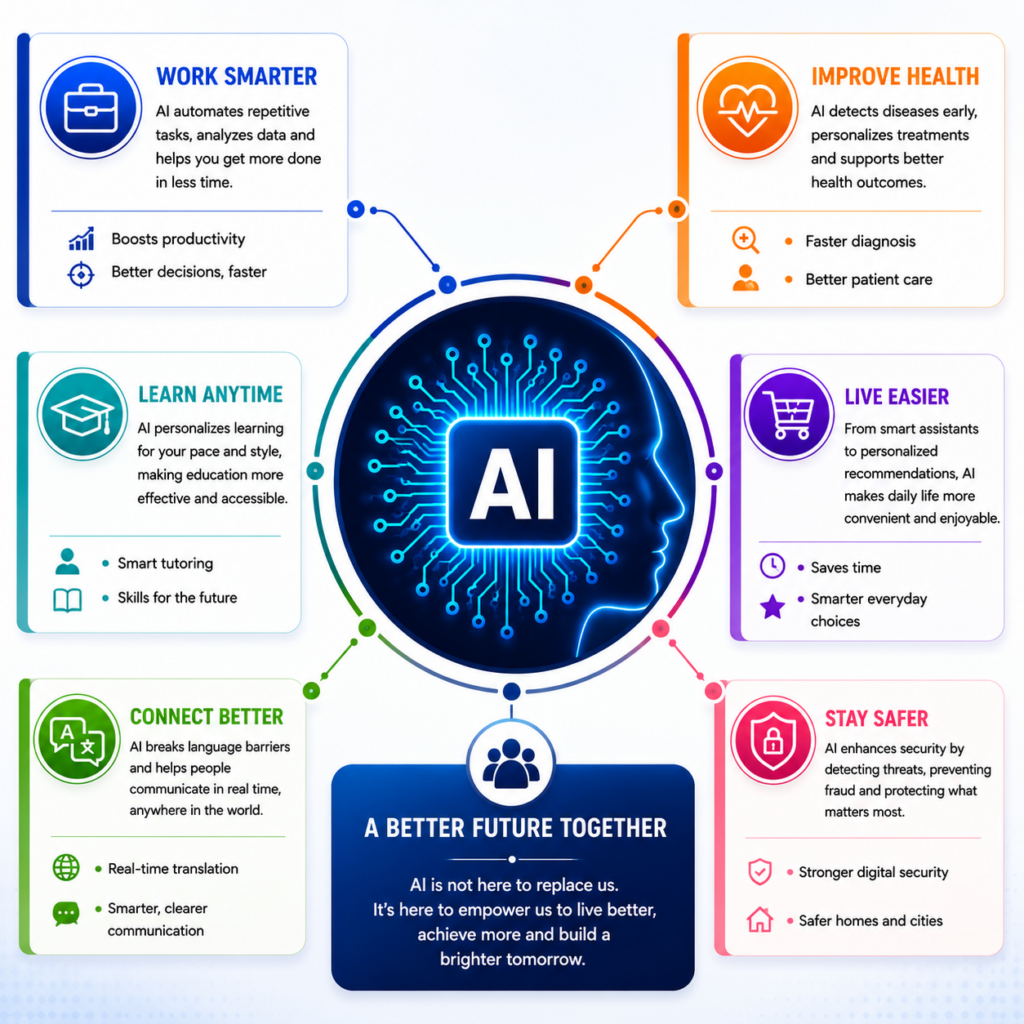
AI is transforming everyday life through smarter apps, automation, personalized recommendations, healthcare tools, virtual assistants, and workplace productivity systems.
Why is India important in the global AI industry?
India is rapidly adopting AI across healthcare, education, business, agriculture, and regional language technology, making it one of the fastest-growing AI markets globally.
Is AI replacing human jobs completely?
AI is automating repetitive work, but human creativity, communication, emotional intelligence, and strategic thinking remain highly valuable.
Why are regional languages growing online because of AI?
AI-powered translation, speech recognition, and voice search tools are making digital platforms more accessible for non-English-speaking users.
What are the biggest concerns around AI in 2026?
Privacy, data ownership, AI surveillance, deepfakes, misinformation, and emotional dependency on technology are some of the major concerns being discussed globally.