
Airtel launches India’s first Priority 5G service with network slicing technology. Check plans, pricing, benefits, internet speed improvements, and how it works.
Airtel First Priority 5G Explained: Why This Could Finally Fix Slow Internet in Crowded Areas
Nothing is more frustrating than seeing full network bars on your phone while the internet simply refuses to work.
You try sending a WhatsApp message at a concert. It doesn’t go through.
You open Instagram during an IPL match. Stories stop loading.
You attempt a UPI payment at a crowded railway station. The app freezes.
We’ve all experienced it.
And that’s exactly the problem Bharti Airtel is now trying to solve with its newly launched Priority 5G plans powered by network slicing technology.
The name may sound technical, but the idea is surprisingly simple.
Airtel wants to give premium users faster and more stable 5G connectivity, especially in places where mobile networks usually struggle because too many people are connected at once.
If this works as promised, it could become one of the first 5G features in India that users genuinely notice in daily life.
Key Takeaways
- Airtel has launched new Priority 5G plans in India
- The service uses advanced network slicing technology
- Premium users may get better speeds during network congestion
- Gamers, travelers, and remote workers could benefit the most
- Airtel Priority plans start from ₹449
- The technology is already being tested globally
- Airtel’s move could change how 5G services are sold in India
So, What Exactly Is Airtel’s Priority 5G?
Think of Airtel’s Priority 5G as a premium fast lane for mobile internet.
Normally, everyone connected to the same mobile tower shares the same network capacity. That’s why internet speeds often slow down in crowded places like stadiums, airports, shopping malls, or concerts.
But with Airtel’s Priority 5G plans, certain users may get preferential access to the network during congestion.
In practical terms, that could mean:
- Faster internet speeds
- Smoother video streaming
- Better online gaming performance
- More stable video calls
- Less lag during peak hours
So even if thousands of people are using the network at the same time, premium users may still get a smoother experience.
Airtel 5G “NEW PLANS” launched based on 5G network slicing
Airtel Priority 5G Plans and Pricing
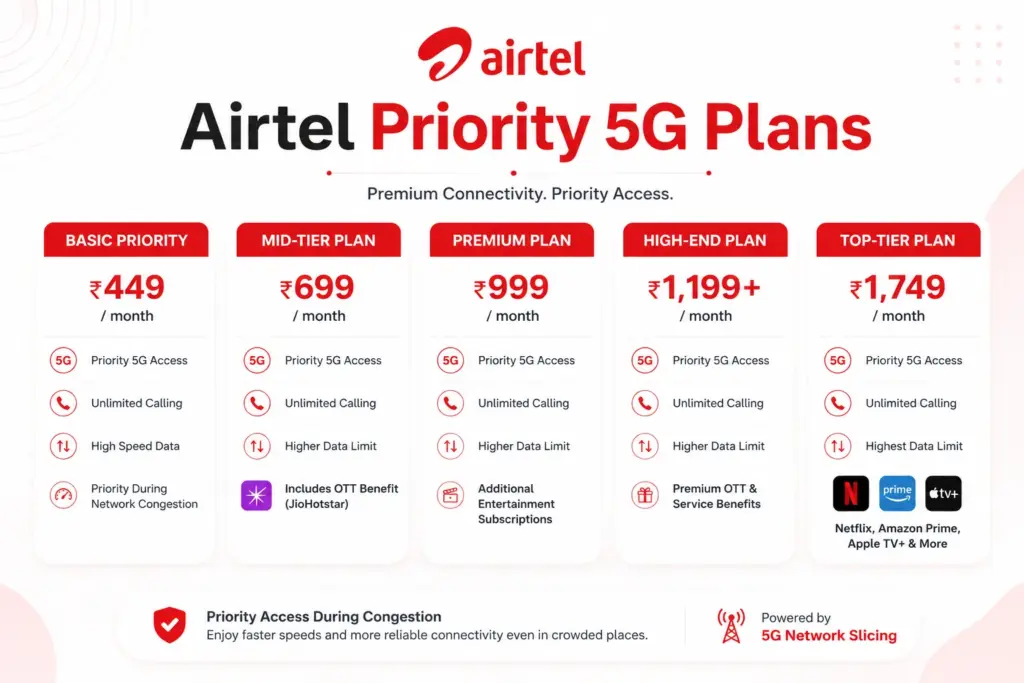
Airtel says its new Priority 5G service is available across select postpaid plans starting at ₹449 per month.
Higher plans include entertainment subscriptions and additional premium benefits.
Here’s a quick look at the currently available Airtel Priority plans:
| Plan | Starting Price | Key Benefits |
|---|---|---|
| Basic Priority Postpaid | ₹449 | Priority 5G access, unlimited calling, data benefits |
| Mid-Tier Plan | ₹699 | Includes OTT benefits and higher data limits |
| Premium Plan | ₹999 | Additional entertainment subscriptions |
| High-End Plan | ₹1,199+ | Enhanced OTT and premium service benefits |
| Top-Tier Plan | ₹1,749 | Netflix, Amazon Prime, Apple TV+ and more |
Airtel says eligible users may receive these benefits automatically depending on their plan and network availability.
Airtel Priority 5G vs Regular Airtel 5G Plans
| Feature | Regular Airtel 5G | Airtel Priority 5G |
|---|---|---|
| Network Access | Shared equally among users | Priority access during congestion |
| Speeds in Crowded Areas | Can slow down | Expected to remain more stable |
| Gaming Performance | Standard latency | Lower latency possible |
| Video Calls | May buffer during congestion | More stable experience |
| Streaming Quality | Can fluctuate | Smoother during peak traffic |
| Target Users | General users | Heavy internet users & professionals |
| Technology Used | Standard 5G | 5G network slicing |
| Pricing | Regular pricing | Premium pricing |
What Is Network Slicing in Airtel 5G?
This is where the real 5G technology comes into play.
Network slicing allows telecom companies to divide a single physical 5G network into multiple virtual sections, also known as “slices.”
y=Dedicated Virtual 5G Network Slicesy=\text{Dedicated Virtual 5G Network Slices} y=Dedicated
Each slice can be customized for a different type of usage.
For example:
- One slice for online gaming
- One for video streaming
- One for businesses
- One for emergency services
- One for premium mobile users
Instead of treating every user exactly the same, the network intelligently allocates resources depending on the service requirement.
In simple terms, network slicing creates separate digital lanes inside the same 5G network.
And that’s one of the biggest advantages of standalone 5G technology.
A Simple Real-Life Example
Imagine you’re stuck in heavy traffic during office hours.
Now picture one dedicated lane reserved for emergency vehicles or VIP movement. While regular traffic moves slowly, that special lane continues flowing smoothly.
That’s basically how Airtel’s Priority 5G works.
Premium users get access to a kind of digital express lane on the 5G network.
So when the network becomes crowded, their internet experience may remain faster and more stable than regular users.
Other Countries Are Already Using This Technology
India is not the first country exploring network slicing.
Telecom companies around the world are already testing and using it in different ways.
South Korea
In South Korea, telecom providers have experimented with dedicated 5G slices for cloud gaming and ultra-HD streaming to reduce lag during heavy traffic periods.
Germany
Factories in Germany use network slicing for robotics and industrial automation where stable low-latency connectivity is critical.
United States
Major telecom carriers in the United States have explored priority 5G access for businesses, emergency services, and crowded public events.
So Airtel’s move is part of a much bigger global shift toward smarter and more personalized 5G networks.
Why Airtel Is Introducing Priority 5G Plans
There’s a very simple reason behind this move: mobile internet demand is exploding.
India is already among the world’s biggest mobile data-consuming markets, with users consuming massive amounts of data every month.
People today:
- stream more videos
- play more online games
- attend virtual meetings
- upload large files
- rely heavily on cloud apps
As millions of users move to 5G, network congestion is becoming a serious challenge.
Airtel likely sees Priority 5G as a way to improve user experience while also creating premium services that users may be willing to pay extra for.
Who Could Benefit the Most From Airtel Priority 5G?
Not everyone needs a premium 5G experience.
But some users could genuinely notice the difference.
Gamers
Lower latency can improve online gaming performance and reduce lag spikes.
Remote Workers
Stable video calls and smoother cloud access are important for work meetings.
Frequent Travelers
Airports and railway stations often suffer from overloaded mobile networks.
Content Creators
Uploading videos or livestreaming from crowded locations becomes easier with stable internet speeds.
Sports and Concert Fans
This may be one of the biggest real-world use cases.
If you’ve ever tried uploading Instagram Stories during an IPL match or live concert, you already know how unreliable mobile internet can become.
Are There Any Downsides to Airtel Priority 5G?
While the technology sounds exciting, there are still some concerns.
Premium Users May Get Better Internet Than Others
Some experts worry that network slicing could eventually create a “two-tier internet” experience.
In simple words:
- Users paying more may get smoother connectivity
- Regular users may continue facing congestion
That debate is already happening globally.
Pricing Will Matter
If Airtel prices these plans too aggressively, many users may prefer sticking to regular 5G plans.
Real-World Performance Still Needs Testing
Marketing promises and actual performance are often very different things.
The success of Airtel’s Priority 5G will ultimately depend on how well the company implements it across Indian cities.
What Could Come Next?
In the future, telecom companies may introduce the following:
- Gaming-focused 5G plans
- Premium streaming plans
- Enterprise-grade mobile connectivity
- Event-specific priority access
- Ultra-low latency cloud services
This could completely change how mobile internet plans are sold in India.
Will You Need a New Phone for Airtel Priority 5G?
Most likely, users will need:
- A compatible 5G smartphone
- Airtel 5G coverage in their area
- A supported Priority 5G plan
Some older 5G devices may not fully support advanced standalone 5G features depending on hardware compatibility.
FAQs
What is Airtel Priority 5G?
Airtel Priority 5G is a premium service that gives users priority access to the network during congestion using network slicing technology.
What is network slicing in simple words?
Network slicing divides one 5G network into multiple virtual sections for different users and services.
Will Airtel Priority 5G improve internet speed?
During crowded situations or peak hours, premium users may experience faster and more stable connectivity.
Is Airtel Priority 5G useful for gaming?
Yes. Lower latency and more stable connectivity could improve online gaming performance.
Will Airtel charge extra for Priority 5G?
Most likely yes, because it is being positioned as a premium service.
Is Airtel Priority 5G available everywhere in India?
Availability will depend on Airtel’s 5G rollout and infrastructure in different cities.
Final Thoughts
For years, telecom companies mainly competed on cheaper data packs and unlimited calling offers.
But the 5G era is changing that.
Now the competition is slowly shifting toward user experience and service quality.
Airtel is clearly betting that users will eventually pay more for smoother and more reliable internet, not just bigger data packs.
And honestly, that shift has already started globally.
If Airtel can consistently deliver faster speeds in crowded places where mobile internet usually struggles, Priority 5G may become one of the first truly useful consumer-focused 5G upgrades in India.