
What would happen if Google suddenly disappeared? Explore how Search, Gmail, YouTube, Android, Maps, businesses, and the global internet would be affected in the first 24 hours and beyond.
Imagine waking up tomorrow morning, unlocking your phone, opening Google Search—and seeing nothing.
No search results.
No Gmail.
No YouTube.
Google Maps refuses to load.
Businesses around the world begin reporting outages, millions of Android users notice missing services, and countless websites lose access to tools they rely on every day.
At first, people assume it’s another temporary outage. But as the hours pass, one thing becomes clear: Google has disappeared.
Although this scenario is purely hypothetical, it raises an important question.
How much of modern life depends on Google?
The answer is far more than most people realize.
Over the past two decades, Google has grown from a search engine into one of the world’s largest technology ecosystems. From communication and navigation to online advertising, cloud computing, and mobile software, Google’s products have become deeply integrated into daily life.
So what would actually happen if Google disappeared overnight?
Let’s walk through the first 24 hours—and explore the ripple effects that would follow.
Why Google Matters More Than Most People Think
When people hear the word “Google,” they usually think of search.
In reality, Google provides an enormous collection of services used by billions of people every day.
Some of its most widely used products include:
- Google Search
- Gmail
- YouTube
- Google Maps
- Google Drive
- Google Photos
- Google Calendar
- Google Chrome
- Google Workspace
- Google Cloud
- Google Play Store
- Google Ads
- Google Analytics
- Firebase
- Google Meet
- Google Assistant
Many people use several of these services every single day without even noticing how connected they are.
Businesses, schools, governments, developers, creators, and consumers all depend on Google’s infrastructure in different ways.
That dependence becomes obvious only when we imagine it suddenly disappearing.
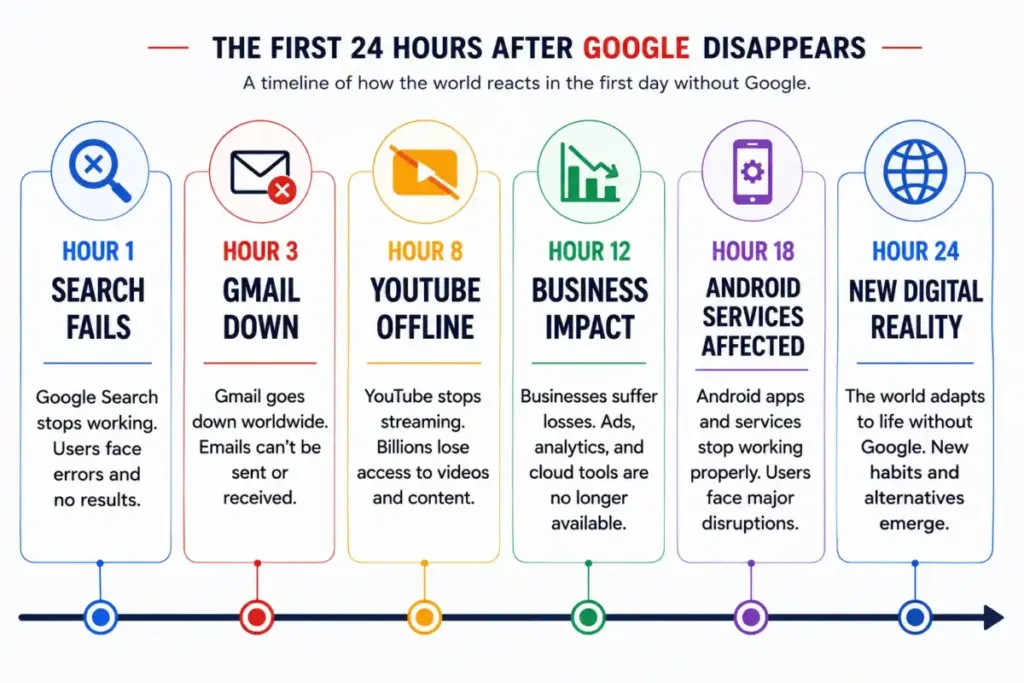
Hour 1: Confusion Turns Into Panic
The first signs appear early in the morning.
Someone searches for today’s weather.
Nothing appears.
Another person tries searching for a recipe.
The page never loads.
Students cannot look up homework answers.
Journalists struggle to verify breaking news.
Within minutes, people begin asking the same question on social media:
“Is Google down?”
Platforms like X, Reddit, Facebook, LinkedIn, and Discord quickly fill with screenshots and outage reports.
Many users keep refreshing their browsers, assuming the problem will resolve itself.
But it doesn’t.
The world’s most visited search engine has vanished.
Hour 3: Gmail Stops Working
For millions of people, Gmail is much more than an email service.
It serves as their online identity.
People receive:
- Banking notifications
- School updates
- Medical appointments
- Job interview invitations
- Government notices
- Business contracts
- Password reset emails
Without Gmail, communication slows dramatically.
Remote workers cannot access important conversations.
Companies delay projects.
Students miss assignment notifications.
Freelancers lose contact with clients.
For many organizations, email is the backbone of daily operations, and its disappearance would create immediate confusion.
Hour 5: Navigation Becomes More Difficult
Google Maps has become the default navigation tool for millions of drivers and travelers.
Without it, people would suddenly lose:
- Turn-by-turn navigation
- Live traffic updates
- Business listings
- Public transportation routes
- Location sharing
- Reviews and ratings
Taxi drivers, delivery workers, tourists, and commuters would immediately begin downloading alternative navigation apps.
Services such as Apple Maps and OpenStreetMap would likely experience a massive surge in traffic.
Even then, switching platforms overnight would not be seamless.
Hour 8: YouTube Goes Offline
For many people, YouTube is entertainment.
For millions of others, it is a career.
If YouTube disappeared:
- Educational tutorials would become unavailable.
- Music videos would disappear.
- Podcasts would lose major distribution channels.
- Businesses would lose marketing content.
- Teachers would lose educational resources.
- Content creators would lose advertising revenue.
Viewers would naturally look toward alternatives like Vimeo or Twitch.
However, no existing platform currently matches YouTube’s enormous global library of educational, entertainment, and instructional content.
Years of videos could instantly become inaccessible.
Hour 12: Businesses Feel the Biggest Shock
By midday, businesses around the world begin experiencing serious operational challenges.
Many organizations rely heavily on Google’s business tools, including:
- Google Workspace
- Google Meet
- Google Drive
- Google Docs
- Google Sheets
- Google Analytics
- Google Ads
- Firebase
- Google Cloud
Without these services:
- Marketing campaigns pause.
- Advertising stops running.
- Teams lose collaboration tools.
- Meetings are cancelled.
- Customer data becomes harder to access.
- Mobile applications experience service disruptions.
For startups and technology companies, Google’s infrastructure often supports critical daily operations.
The financial impact could be significant within just a few hours.
Hour 18: Android Users Notice Major Changes
Many people assume Android and Google are exactly the same.
They are closely connected, but not identical.
Android is an open-source operating system, meaning phones would continue functioning.
However, many Android devices depend on Google Mobile Services for important features.
Users might experience problems with:
- Google Play Store
- Google Photos
- Contact synchronization
- Device backups
- Google Assistant
- Location services
- App verification
- Push notifications
Apps that depend on Google’s APIs may stop working correctly or lose certain functionality.
While phones would not become useless, many familiar features would disappear.
Hour 24: The Internet Keeps Running
One of the biggest misconceptions is that losing Google would mean losing the internet.
That isn’t true.
The internet consists of millions of independent networks operated by governments, businesses, universities, nonprofits, and private organizations.
Most websites would continue operating.
Streaming services, online stores, messaging apps, banking websites, and countless other services would remain available.
What changes is how people access and discover information.
Without Google Search, users would need new ways to navigate the web.
The internet would continue—but daily habits would change overnight.
Industries That Would Be Hit the Hardest
Some industries would experience immediate disruption.
Digital Marketing
Millions of businesses rely on Google Ads for customer acquisition.
Without advertising campaigns, online sales could decline quickly.
Online Publishing
Many websites receive a large portion of their traffic from Google Search.
Publishers would need to adapt to other discovery channels.
Cloud Computing
Organizations using Google Cloud would need contingency plans if services became unavailable.
Software Development
Developers using Firebase or Google APIs could face unexpected application failures.
Education
Schools and universities using Google Classroom, Docs, Meet, and Drive would need alternative collaboration platforms.
Who Would Benefit?
Whenever one major platform disappears, competitors usually gain new users.
Several companies would likely experience record growth.
Search Engines
- Microsoft Bing
- DuckDuckGo
- Brave Search
Email Services
- Microsoft Outlook
- Proton Mail
Navigation
- Apple Maps
- OpenStreetMap
Cloud Storage
- Microsoft OneDrive
- Dropbox
Video Platforms
- Vimeo
- Twitch
- Dailymotion
Productivity Tools
- Microsoft 365
- Zoho Workplace
- Nextcloud
Even so, replacing Google’s complete ecosystem would take years.
No single company currently provides an identical combination of search, advertising, cloud computing, productivity software, mobile services, AI tools, mapping, and video hosting at Google’s scale.
Could Another Company Replace Google?
The short answer is no—not immediately.
Google has spent decades building:
- One of the world’s largest search indexes
- Global cloud infrastructure
- Advanced mapping systems
- AI research platforms
- Massive advertising networks
- Billions of daily users
- Data centers across multiple continents
Even if competitors gained millions of users overnight, recreating Google’s ecosystem would require years of investment, engineering, and infrastructure.
The digital world would eventually adapt, but the transition would not happen overnight.
What This Scenario Teaches Us
This thought experiment highlights an important lesson.
Convenience often leads to dependence.
Whether you’re an individual or a business, relying entirely on one technology ecosystem creates risk.
Practical ways to reduce that risk include:
- Keeping backups of important files.
- Exporting contacts regularly.
- Using a password manager that works independently.
- Knowing alternative email providers.
- Maintaining offline copies of essential documents.
- Diversifying cloud storage.
- Testing backup communication methods.
These habits improve digital resilience regardless of which platforms you use.
Frequently Asked Questions
Would the internet stop working if Google disappeared?
No. The internet is decentralized. Although Google’s services are widely used, millions of websites and networks would continue operating.
Would Android phones stop working?
No. Android devices would still function, but many Google-powered services such as the Play Store, backups, Maps integration, and synchronization features could be affected.
Would YouTube disappear?
If Google’s services completely disappeared in this hypothetical scenario, YouTube would also become unavailable because it is owned and operated by Google.
Would businesses lose their websites?
Not necessarily. Websites hosted outside Google’s infrastructure would remain online. However, organizations relying on Google Cloud or Google Workspace could face operational disruptions.
Which companies might benefit the most?
Search engines such as Bing and DuckDuckGo, email providers like Outlook and Proton Mail, navigation platforms including Apple Maps, and cloud providers such as Microsoft and Amazon Web Services could see significant increases in users.
Is Google too big to fail?
Google is one of the world’s largest technology companies, but like any organization, it is not immune to technical failures, regulatory changes, or market disruption. This article explores a fictional scenario rather than predicting a real event.
Can people prepare for major online service outages?
Yes. Maintaining backups, using multiple cloud providers when appropriate, exporting important data, and keeping offline copies of essential files can reduce the impact of unexpected outages.
Why is Google so deeply integrated into everyday life?
Because its services span search, email, cloud computing, mobile software, productivity tools, mapping, advertising, AI, and online video, many people use several Google products every day without realizing how interconnected they are.
Final Thoughts
Google has evolved far beyond a search engine.
Today it supports communication, navigation, online learning, cloud computing, digital advertising, software development, mobile applications, entertainment, and business operations for billions of users worldwide.
If Google disappeared tomorrow, the internet would not collapse.
People would still browse websites, send messages through other platforms, and access countless online services.
However, daily routines would become far more complicated as individuals, businesses, and organizations rushed to adopt alternatives.
This thought experiment reminds us of an important principle of the digital age:
Convenience is valuable, but resilience is essential.
Keeping backups, understanding alternative services, and avoiding dependence on a single platform can help individuals and businesses adapt more quickly when unexpected disruptions occur.
Technology will continue to evolve, and new platforms will emerge. But Google’s influence on the modern internet remains one of the most significant stories in the history of technology.
What do you think? If Google disappeared tomorrow, which Google service would you miss the most—Search, Gmail, YouTube, Maps, or something else? Share your thoughts in the comments.
Read More articles: